What Should Buyers Check Before Custom Bags Are Shipped?
Check the production bags against the approved specification and sample. Review dimensions, materials, stitching, hardware, branding, agreed functional tests, quantity and packaging. Define the inspection scope and acceptance criteria before production so the factory and inspector evaluate the same requirements.
A pre-shipment inspection supports a shipment decision. It does not prove that every unit is defect-free or replace laboratory testing required for particular claims or markets.
1. Prepare the Inspection Reference Pack
Provide the final specification revision, approved artwork, material references and identified sample. Include the quantity by style and color, packaging instructions and any agreed test methods.
Resolve conflicting instructions before inspection. If the sample differs from the written specification, state which requirement applies and record the approved change.
2. Agree on Sampling and Acceptance
Confirm how items will be selected across the shipment, including different styles, colors and cartons. Representative selection is more useful than reviewing only pieces chosen for display.
If an acceptance-sampling plan is used, document the applicable plan, inspection level and defect classifications with the inspection provider. Avoid inserting a generic AQL number into an order without defining how it will be applied.
Specify which findings require correction, further review or rejection, and identify who has authority to release the shipment.
3. Review Dimensions and Construction
Measure using the agreed method and tolerances. For flexible bags, clarify whether measurements are taken flat, filled or in another defined condition.
Inspect the lining, pockets, seam alignment and handle attachments. Record defects such as open seams, skipped stitches or loose components against the agreed criteria rather than relying on a general description of “good workmanship.”
| Check | Review Against | Record in the Report |
|---|---|---|
| Product identity | Style, color and order specification | Inspected variants and their identification |
| Dimensions | Measurement method and approved tolerances | Actual measurements and deviations |
| Materials | Approved material and color references | Visible differences and supporting documents reviewed |
| Construction | Seams, lining, pockets and reinforcement details | Defect location, photographs and occurrence |
| Hardware | Specified zippers, buckles and other components | Function, attachment and visible finish issues |
| Branding | Approved artwork, size and placement | Text errors, position and appearance |
| Functional tests | Agreed method and acceptance criteria | Conditions, sample count and results |
| Packing | Labels, quantities and packing instructions | Carton identification and observed discrepancies |
4. Define Functional Tests Before the Inspection
Match tests to the intended use. A lightweight giveaway tote and a backpack intended to carry equipment should not automatically use the same test program.
For a load test, agree on the load, distribution, duration or cycles, handling method and failure criteria. For closures, define the operation and number of cycles where required. Do not treat one manual pull on a handle as evidence of a verified load rating.
QIMA lists seam strength, static and dynamic load, zipper and other evaluations among its bag and luggage testing services. Select methods appropriate to your product rather than assuming every available test is necessary.
5. Check Branding and Retail Presentation
Compare the logo, text and placement with the approved artwork. Include woven labels, hang tags, zipper pullers and other branded components in the review.
Where barcodes are required, verify the printed samples using an appropriate scanning check and confirm the associated item information. A visually correct label can still be assigned to the wrong style or color.
Inspect the product inside its intended packaging to check fit, presentation and whether important information is visible.
6. Separate Visual Inspection from Material Verification
Appearance alone cannot confirm fiber composition, recycled content or a chemical requirement. Identify the supporting documentation or testing required for those claims before ordering.
Agree whether existing reports are applicable to the actual material and product being supplied. Do not assume that a report for another fabric or earlier order automatically covers the current shipment.
QIMA also distinguishes on-site inspection from laboratory evaluation in its pre-shipment inspection guidance.
7. Review Quantity and Packing Details
Check the declared order split, quantities per pack, labels and carton marks. Record the number of cartons available and the scope of the quantity verification performed.
Confirm that the packing arrangement matches the accepted instructions. If a transport-related test is required, agree on its method and sample scope separately.
8. Close Findings Before Shipment Release
Ask for a report that links each finding to a requirement, photograph or test result. Agree on correction and follow-up verification for unresolved issues.
Illustrative example: the bags match the approved appearance, but a pocket is too small for the specified product insert. The issue should be assessed against the agreed fit requirement and corrected before release, rather than dismissed because the exterior looks acceptable.
Keep the inspection outcome and shipment authorization separate. Record who approved release and any conditions attached to that decision.
Buyer Questions
Does sample approval replace pre-shipment inspection?
No. The approved sample defines a reference. Inspection evaluates the production shipment against the agreed requirements.
Should every bag be inspected?
The appropriate scope depends on the product and purchasing requirements. Agree on sampling or specified full checks rather than assuming one approach suits every order.
Can photographs replace an inspection report?
Photographs support a report but may not show sample selection, measurements or test conditions. Ask for the findings and inspection scope in writing.
What happens when the inspection identifies defects?
Apply the agreed acceptance criteria, document corrective actions and determine whether follow-up inspection is needed before shipment.
Include Inspection Requirements in Your Bag Enquiry
Send Largeng Bags your product specification, intended use, quantity and required quality checks. Ask for the inspection and documentation scope to be included in the quotation before production begins.
For supplier evaluation, read how to check a bag manufacturer before your first order.
Related Guides
- From Sketch to Shipment: The 5-Step Custom Bag Production Process
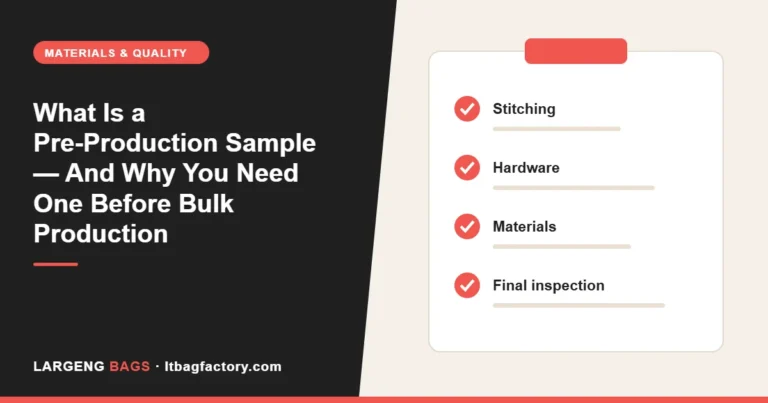
- What Is a Pre-Production Sample — And Why You Need One Before Bulk Production
- Custom Bag Manufacturer in China: Buyer Checklist for Brands
- 5 Red Flags to Watch Out For When Assessing Bag Quality (And How We Avoid Them)
- Custom bag manufacturing services — request a quote from our Quanzhou factory