For B2B bag buyers, there is no nightmare worse than the “Golden Sample Trap.” You receive a prototype from a new supplier, and it is flawless—the stitching is straight, the zippers glide smoothly, and the fabric feels premium. Confident in the quality, you place a large bulk order.
But when the shipment arrives at your warehouse, reality hits. The mass-produced bags suffer from stuck zippers, loose threads, uneven tension, and a strange chemical odor. Soon, your Amazon listing or retail stores are flooded with 1-star reviews and return requests. Your brand reputation, built over years, vanishes overnight.
In the bag manufacturing industry, consistency is everything. To protect your brand, you need to know how to spot factory shortcuts. Here are 5 quality red flags you must watch out for when assessing bag quality, and a behind-the-scenes look at how LT Bag Factory eliminates them.
1. The Red Flags Checklist: Spotting Factory Shortcuts
Red Flag 1: Sticking or Misaligned Zippers
Zippers are the most frequently used component of any bag. Cheap factories often use generic, non-branded zippers to save pennies. If a zipper catches, splits, or feels rough during your first few test pulls, it will definitely fail under daily consumer usage.
- How We Avoid It: We partner with industry-standard hardware brands like YKK and SBS. Furthermore, every batch of zippers goes through a mechanical fatigue test—pulled back and forth 5,000 times before ever hitting the sewing line.
Red Flag 2: Missing “Bartack” Reinforcements at Stress Points
Look closely at where the shoulder straps, top handles, or load-bearing D-rings attach to the bag body. If they are attached with just a single straight line of stitching, the strap will rip out the moment a customer puts a laptop or heavy books inside.
- How We Avoid It: LT Bag Factory mandates computerized Bartack (heavy-duty reinforced stitching) on all high-stress connection joints. This distribution of weight ensures our backpacks and duffles can easily pass a 20kg drop-test.
Red Flag 3: Raw, Unbound Interior Edges
Turn a sample bag completely inside out. Are the raw fabric edges exposed, or are they neatly covered with binding tape? Exposed raw edges will fray rapidly inside the bag, clogging zippers with loose threads and making the interior look incredibly cheap.
- How We Avoid It: Every interior seam in an LT bag is finished with double-stitched nylon or polyester binding tape. It ensures a clean aesthetic and prevents fraying for the entire lifespan of the product.
Red Flag 4: Uneven Stitching Density (SPI)
Stitches Per Inch (SPI) dictates seam strength. Low-quality manufacturers increase stitch length (lower SPI) to speed up assembly lines and save thread. This results in loose, weak seams that pull apart under tension.
- How We Avoid It: Our automated sewing machines are calibrated to a strict standard of 7–9 stitches per inch for standard fabrics, ensuring uniform density, straight lines, and maximum structural integrity.
Red Flag 5: Pungent Chemical Odors (Toxic Backing Coatings)
If you open a box of sample bags and smell a sharp, toxic plastic odor, the factory likely used cheap PVC or low-grade PU backing for waterproofing. These coatings often contain harmful phthalates or heavy metals that fail international safety standards.
- How We Avoid It: We source materials that comply with REACH and California Proposition 65 regulations. Our fabrics use eco-friendly water-based coatings that are completely odorless and non-toxic.
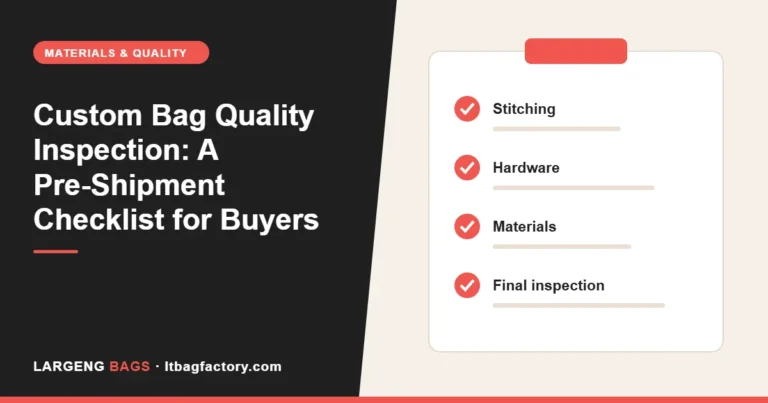
2. Our 7-Stage Quality Control Protocol
We believe quality cannot be checked into a product at the very end; it must be built into every step of the manufacturing journey. At LT Bag Factory, your bulk order passes through a strict 7-stage quality gate:
| QC Stage | What We Check | Goal |
| 1. IQC (Incoming Quality Control) | Raw fabrics, hardware, webbings, and linings. | Reject defective raw materials before production begins. |
| 2. Pre-Production Match | First piece off the assembly line compared to approved sample. | Ensure absolute alignment with client tech packs. |
| 3. In-Process QC (IPQC) | Stitching accuracy and component alignment during assembly. | Catch and fix errors immediately at individual sewing stations. |
| 4. Tensile & Stress Testing | Pull-testing handles, straps, and buckle strength on random units. | Verify real-world durability and load capacity. |
| 5. Cosmetic Trimming | Thread trimming, cleaning, and hardware polishing. | Deliver a clean, premium product ready for retail shelves. |
| 6. Final OQC (Outgoing QC) | AQL 2.5 statistical sampling inspection on packed cartons. | Ensure zero batch defects before warehouse loading. |
| 7. Metal Detection | Running 100% of finished bags through a needle detector machine. | Guarantee consumer safety by catching broken sewing needles. |
🛠️ Experience Our Craftsmanship Firsthand
Don’t take our word for it—test our quality yourself. We are so confident in our production standards that we offer serious B2B buyers a “Craftsmanship Sample Kit” showcasing our sewing density, bartack reinforcement, and certified hardware.
Partner with a Reliable Bag Manufacturer
Your brand identity is tied directly to the quality of your products. Don’t let a low-cost, low-quality factory compromise your business growth, trigger costly returns, or damage your customer relationships.
At LT Bag Factory, we pride ourselves on delivering retail-ready consistency on every single production run, whether it’s 500 units or 50,000 units.
Let’s Build a Product Your Customers Will Love
Planning your next premium bag line? Reach out to our B2B quality assurance team today. Share your quality specifications, and let us show you how we can elevate your product line.
📩 Contact Our Quality Control Experts
Get a manufacturing partner who cares about your brand reputation as much as you do.
👉 [Inquire Now & Talk to a Product Engineer]
Related Guides
- Custom bag manufacturing services — request a quote from our Quanzhou factory