TL;DR: Genuine leather (especially full-grain) lasts 10–30+ years and develops character with age, but costs more and is animal-derived. PU leather is affordable and consistent but typically peels within 3–5 years. Vegan/plant-based leather offers sustainability credentials but varies widely in quality. For bag brands, the right choice depends on your price point, target customer, and brand values.
Why Material Is the Most Important Decision You Will Make
Everything about a bag — its durability, its price point, its brand story, its environmental impact, and its customer satisfaction rate — flows from the material it is made from. Yet many bag brand founders spend more time choosing hardware finishes than they do understanding the material that makes up 60–70% of the bag’s cost and determines its entire lifespan.
This guide gives you the complete, honest picture of how the three main bag material categories compare — so you can make the right choice for your brand and your customer.
Understanding the Leather Quality Hierarchy
Before comparing leather to alternatives, it is important to know that “leather” is not a single quality level — it is a spectrum. The term “genuine leather” is actually a marketing-friendly label that conceals significant quality differences.
The leather quality hierarchy, from best to worst:
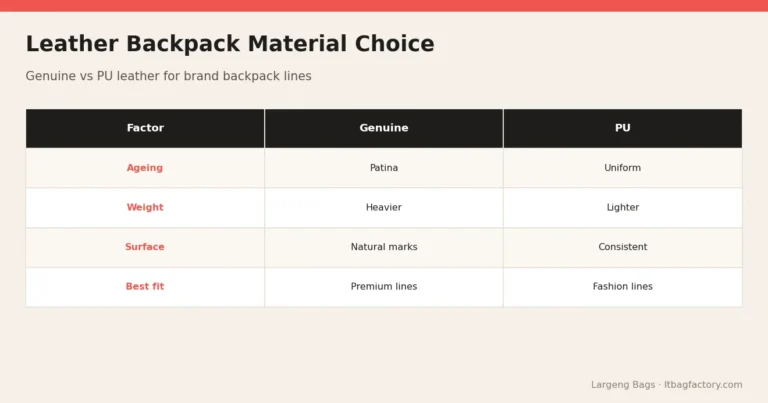
Full-grain leather: The outermost, most durable layer of the hide. Natural grain is intact, including surface markings from the animal’s life (scars, insect bites, texture variation). These imperfections are signs of quality, not flaws. Full-grain leather develops a rich patina with use and age. Expected lifespan: 20–50+ years. This is the leather used by luxury houses.
Top-grain leather: The outer layer of the hide with the surface sanded or buffed to remove imperfections, then finished with a protective coating. More uniform appearance than full-grain. Less breathable and develops less patina. Expected lifespan: 10–20 years. Used by mid-range fashion brands.
Corrected-grain leather: Full-thickness hide that has been heavily sanded and given an artificial grain embossed on the surface. Uniform appearance, consistent color, low cost. Commonly used in affordable leather goods. Expected lifespan: 5–10 years.
Bonded leather: Leather scraps and dust compressed and bonded with polyurethane adhesive, then given a leather-look surface coating. Least durable — surface typically starts peeling within 1–3 years. Often labeled “genuine leather,” which is technically correct (it contains leather) but deeply misleading about quality.
When a factory says “genuine leather,” always ask which grade. Full-grain and top-grain are substantively different products from corrected-grain and bonded leather, despite all being technically “genuine.”
PU Leather: The Workhorse of the Fashion Bag Market
Polyurethane (PU) leather is a synthetic material made by coating a fabric base (usually polyester) with a polyurethane polymer. It is the dominant material in the global fashion bag market — from high-street retailers to mid-range DTC brands.
How PU leather is made: A woven or non-woven polyester fabric is coated with one or more layers of polyurethane, then embossed with a texture (smooth, pebbled, croc-print, etc.) and finished with a protective top coat. The result looks and feels like leather at initial contact.
Performance over time: PU leather performs well for 1–3 years under regular use before showing signs of wear. The most common failure mode is delamination — the polyurethane coating separates from the base fabric in areas of repeated flexing (handle attachment points, corners, fold lines). Once delamination begins, it cannot be repaired.
Why brands choose PU leather:
- Cost: typically 60–80% less per unit than comparable genuine leather
- Consistency: color and texture are perfectly uniform (no natural variations)
- Color range: available in virtually any color, including vibrant and metallic options unavailable in natural leather
- Water resistance: inherently more water-resistant than untreated leather
- Vegan-friendly: no animal products
What to look for in quality PU leather:
- Thickness: 0.8 mm–1.2 mm for fashion bags (thinner = less durable)
- Base fabric: woven polyester base is more durable than non-woven
- Water-based PU vs. solvent-based PU: water-based is safer, of higher quality, and offers better flexibility
- Surface coating hardness: harder coatings resist scuffs; softer coatings feel more luxurious but show wear faster
Vegan Leather: The Category With the Most Variation
“Vegan leather” is a marketing category, not a material specification. It encompasses everything from standard PU leather (which most vegan bags are made from) to genuinely innovative plant-based alternatives.
Standard vegan leather (PU/PVC): Most bags sold as “vegan leather” are PU or PVC — petroleum-based plastics. They are cruelty-free (no animals) but have significant environmental drawbacks: non-biodegradability, microplastic shedding, and chemical-intensive production. PVC is increasingly avoided by quality-conscious brands due to plasticizer migration and disposal issues.
Next-generation plant-based materials:
| Material | Source | Durability | Cost Premium | Market Availability |
|---|---|---|---|---|
| Cactus leather (Desserto) | Nopal cactus (Mexico) | Good | +30–60% vs PU | Growing — several factories certified |
| Apple leather | Apple industry waste (Europe) | Moderate | +20–40% vs PU | Moderate — niche use |
| Pineapple leaf fiber (Piñatex) | Pineapple crop waste | Good | +40–80% vs PU | Moderate — Ananas Anam supply chain |
| Mushroom leather (Mylo) | Mycelium (lab-grown) | Good | +100–200% vs PU | Limited — not yet at scale |
| Wine leather (Vegea) | Grape marc waste (Italy) | Moderate | +40–70% vs PU | Limited — mainly luxury |
| Cork leather | Cork oak bark (Portugal) | Moderate | +10–30% vs PU | Available — well-established |
The sustainability reality: Most plant-based leather alternatives still require PU or other binders to achieve durability and flexibility. Fully bio-based, plastic-free alternatives (like Mirum) exist but are not yet at commercial scale for bag production. When marketing a bag as sustainable, be specific about the material composition and do not overstate environmental claims — consumers and regulators are increasingly scrutinizing greenwashing.
Head-to-Head Comparison for Bag Brand Decisions
| Factor | Full-Grain Leather | Top-Grain Leather | PU Leather | Plant-Based Vegan |
|---|---|---|---|---|
| Expected lifespan | 20–50+ years | 10–20 years | 2–5 years | 3–7 years (varies) |
| Develops patina | Yes — richly | Minimal | No | No |
| Water resistance | Moderate (wax improves) | Good | Excellent | Good |
| Repair/restoration | Yes | Limited | No | Limited |
| Factory cost (tote, relative) | 5–7× | 3–5× | 1× (baseline) | 1.2–2× |
| Retail price positioning | $150–$500+ | $90–$250 | $40–$150 | $60–$200 |
| Sustainable claim | Partially (longevity) | Partially | No | Yes (with caveats) |
| Animal-free | No | No | Yes | Yes |
| Color consistency | Variable (natural) | Good | Excellent | Good |
| Brand story strength | Very strong (heritage) | Strong | Moderate | Strong (sustainability) |
Choosing the Right Material for Your Brand
Choose full-grain or top-grain leather if:
- Your brand positioning is premium or heritage
- Your target customer is 30–55, values quality over trend
- Your retail price is $120+
- Your brand story centers on craftsmanship, longevity, or investment pieces
- You are building a brand where customers will own products for a decade
Choose PU leather if:
- You are launching a first collection and managing budget risk
- Your target customer is trend-driven and rotates bags seasonally
- Your retail price is $40–$120
- You want the widest possible color range for seasonal collections
- Your distribution is primarily Amazon or fast-fashion adjacent channels
Choose plant-based/sustainable vegan if:
- Sustainability is a core brand pillar (not just a marketing claim)
- Your target customer actively researches and values material provenance
- You are targeting EU markets where ESG purchasing is accelerating
- Your retail price is $80–$200 (where the sustainability premium is justified)
- You are willing to invest in material transparency and storytelling
Material Specifications to Request from Your Factory
When ordering, do not accept generic descriptions. Specify:
For genuine leather:
- Grade: full-grain / top-grain / corrected-grain (specify)
- Tanning method: vegetable-tanned / chrome-tanned (vegetable is more sustainable)
- Thickness: 1.0mm / 1.2mm / 1.4mm (thicker = more structure and durability)
- Finish: natural / semi-aniline / pigmented
- Origin country (if relevant to your brand story)
For PU leather:
- Thickness: specify in mm (0.8 mm–1.2 mm recommended for bags)
- Base fabric: woven polyester base preferred
- Type: water-based PU (specify — more sustainable and higher quality)
- Texture: smooth/pebbled / saffiano / croc-embossed (specify)
- Top coat: matte / semi-gloss / high-gloss
For plant-based materials:
- Brand name of material (Desserto, Piñatex, etc. — prevents substitution)
- Composition percentage (e.g., “minimum 50% cactus fiber, remainder water-based PU binder”)
- Certification (ask for the material supplier’s sustainability certificate)
FAQ
Q: Is PU leather always low quality?
A: No. Premium water-based PU on a woven base, properly constructed, produces a bag that holds up well for 2–4 years of regular use. The quality of the construction (stitching, hardware, interior) often matters as much as the material itself.
Q: Does vegan leather break down faster than real leather?
A: Most PU vegan leather does degrade faster than full-grain leather — typically within 3–5 years versus 20+ years for quality leather. However, newer plant-based alternatives are closing this gap. For fast-fashion brand models where customers rotate bags seasonally, this difference matters less.
Q: Can I mix materials in one bag (e.g., PU body with leather trim)?
A: Yes, this is a common practice in mid-range bag manufacturing. Leather handles and trim on a PU body provide a premium feel at a lower cost. Specify which elements are leather and which are PU in your brief and tech pack.
Q: What is the most sustainable choice for a bag material?
A: Longevity is often the most sustainable factor. A full-grain leather bag owned for 20 years may have a lower lifetime environmental impact than five PU bags that each last 4 years, even accounting for leather’s tanning process. The most transparent and honest sustainability story considers use-phase longevity, not just material origin.
Source the Right Material for Your Bag Collection
Largeng Bags (ltbagfactory.com) works with genuine leather (full-grain and top-grain), PU leather (water-based options available), canvas, nylon, and selected plant-based alternatives.
We provide material sample swatches before production so you can see and feel exactly what your bags will be made from.
📩 Request a Material Sample Kit → [Contact Us at ltbagfactory.com]
Related Guides
- Leather Handbag Manufacturer in Quanzhou: Genuine & PU Options for OEM Brands
- How Much Does It Cost to Manufacture a Leather Bag in 2026?
- Canvas vs. Nylon vs. Polyester vs. Leather: The Ultimate Custom Bag Material Guide
- Leather bag and handbag manufacturing — request a quote from our Quanzhou factory