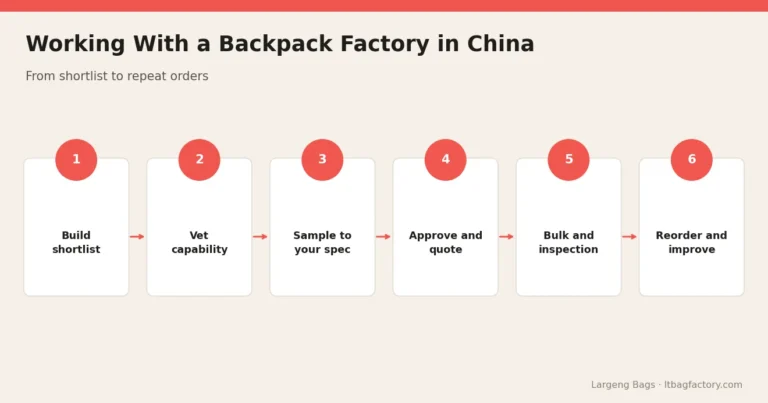
TL;DR: Ordering custom bags from a China factory can save 40–70% versus domestic sourcing — but only if you verify the factory, get everything in writing, insist on pre-production samples, and conduct or commission a pre-shipment inspection. Skip any of these steps and the cost savings evaporate in returns, defects, and delays.
The Truth About Ordering from China in 2026
There is a persistent myth in the sourcing world: that ordering from China is inherently risky and that things will inevitably go wrong. The reality is more nuanced. When things go wrong — and they do, for many buyers — the root cause is almost always a gap in communication, documentation, or verification at a stage when the problem could have been caught and corrected.
China’s manufacturing infrastructure for bags is world-class. The Guangdong and Fujian provinces (particularly Guangzhou and Quanzhou) are home to thousands of factories that supply major global retailers, luxury brands, and fast-fashion labels. The craftsmanship, materials, and production capabilities are genuinely excellent at reputable facilities.
The risk is not the manufacturing quality. The risk is working with the wrong factory or failing to specify and verify your requirements clearly.
This guide tells you exactly how to avoid those mistakes.
Step 1: Verify You Are Talking to the Right Type of Supplier
Before you spend a minute discussing product specifications, determine whether the entity you are communicating with is:
A factory: Has its own production equipment and workforce. Can show you production floor photos or video. Has a verifiable business registration as a manufacturer.
A trading company: Acts as a middleman between you and the actual factory. May not know the specific factory producing your order. Adds a margin (typically 15–30%) to the factory price.
A sourcing agent: Helps you find factories, manages communication, and handles logistics for a fee (typically 5–15% of order value). Can be valuable for complex or large orders.
None of these is automatically bad. But you need to know which one you are dealing with, because it affects your pricing, communication efficiency, and ability to resolve quality issues directly.
How to verify factory status:
- Ask for a copy of their business license (营业执照) — factories list “manufacturing” as their primary business scope
- Request a factory tour via video call (30-minute live walkthrough of production floor)
- Ask how many production lines they operate and what their monthly capacity is
- Search their company name on Alibaba and check the “Verified Supplier” status and years in operation
Step 2: Write a Clear Product Brief Before Any Conversation
The single most common cause of production disappointment is vague communication at the inquiry stage. A factory cannot read your mind. If you say “I want a high-quality leather tote bag,” you will receive a quotation for something that may be completely different from what you imagined.
Your product brief should specify:
- Bag type and general shape (e.g., structured top-handle tote, open-top shopper, zippered crossbody)
- Dimensions (length × height × depth in cm or inches)
- Main material (e.g., 1.0mm top-grain cowhide leather, matte PU leather, 12oz canvas)
- Hardware (gold-tone zinc alloy D-rings, silver stainless steel zipper, antique brass turn-lock)
- Lining (e.g., 210D polyester lining in dark navy, suede-like microfiber)
- Closure (top zip, magnetic snap, flap with turn-lock)
- Strap (short leather handles + removable crossbody strap, length specification)
- Logo (placement, application method: embossed, metal logo plate, woven label, debossed)
- Interior pockets (quantity, type: zipper pocket, open slip pocket, card slots)
- Target retail price (helps the factory calibrate material suggestions)
- Target quantity (initial order quantity and anticipated annual volume)
The more specific your brief, the more accurate and useful the factory’s response will be — and the less room there is for expensive misunderstandings later.
Step 3: Get Multiple Quotations and Compare Correctly
Once you have a detailed brief, send it to 3–5 shortlisted factories. When the quotations come back, resist the temptation to simply choose the lowest price. A low quotation that wins on price but loses on quality specification is not a good deal.
Compare quotations across these dimensions:
- Material specification — Is the factory quoting the same material you specified, or have they substituted a cheaper alternative to hit a lower price? Ask for clarification on every material element.
- Hardware quality — Is the hardware zinc alloy or iron? Does the plating specification match (gold-filled vs gold-plated vs gold-toned)?
- Lead time — Is the stated lead time for production only, or does it include pre-production sampling?
- MOQ — Is the MOQ per style or per order? This significantly affects your first-order economics.
- Sample cost — Is the sample cost refundable against the bulk order? Many reputable factories refund sample costs on the first production order.
- Included services — Does the price include hang tags, polybags, and master carton packaging, or are these additional?
A comprehensive, slightly higher quotation that covers all of these elements is almost always better value than a stripped-down low quote that will accumulate extras.
Step 4: Request Samples — and Test Them Properly
Samples are your quality verification checkpoint before you commit thousands of dollars to bulk production. This stage is non-negotiable.
What to request in your sample order:
- The exact material, color, and hardware you specified for bulk
- Your logo applied exactly as it will appear in production
- Interior pocket layout as specified
- All straps and closure hardware attached and functional
How to evaluate samples when they arrive:
Construction check:
- Pull each strap with moderate force — seams should not separate
- Open and close the zipper 20 times — it should glide without catching
- Press the magnetic snap or turn-lock 10 times — should engage cleanly every time
- Inspect every seam edge — should be finished (not raw) and even
- Check stitch spacing — should be consistent throughout (typically 5–7 stitches per cm)
Material check:
- Is the leather weight what you specified? (Heavier = more durable generally)
- Does the PU leather flex without cracking?
- Is the canvas tightly woven with no loose threads?
- Does the lining lie flat without puckering?
Dimension check:
- Measure length, height, and depth against your specification
- Check strap drop length (distance from top of strap to top of bag when carried)
- Confirm interior pocket dimensions match specification
Logo check:
- Is the logo centered and correctly positioned?
- Is the embossing depth consistent across the surface?
- Are the metal plate edges smooth with no sharp burrs?
If the sample is 85–95% correct, proceed with a revision request. Put your revision notes in writing with photos marking every specific issue. If the sample is below 70% correct, reconsider whether this factory can execute your vision.
Step 5: Document Everything in a Written Purchase Order
A verbal agreement or casual email thread is not a contract. A purchase order (PO) is.
Your PO must include:
- Full factory name and legal address
- Full buyer company name and address
- Product description with style number
- Material specification (verbatim from your approved spec)
- Approved sample reference number or date
- Quantity per style/color
- Unit price
- Total order value
- Payment terms (30% deposit / 70% before shipment is standard)
- Production start date
- Production completion date
- Packaging specification
- Quality standards reference (“Bulk production must conform to approved sample P-001 dated [date] in all material, construction, and dimensional specifications”)
- Inspection clause (“Buyer reserves the right to conduct or commission a pre-shipment inspection”)
- Shipment terms (Incoterm: FOB [port of origin] recommended for new buyers)
The PO is your legal protection. Do not skip it, and do not accept a factory-issued invoice as a substitute — their invoice protects them, not you.
Step 6: Conduct or Commission a Pre-Shipment Inspection
A pre-shipment inspection (PSI) is the most powerful quality control tool available to importers. An independent inspector visits the factory when production is complete (or at least 80% complete) and inspects a random sample of units against your specification.
What a PSI covers:
- Random sampling per AQL 2.5 standard (internationally accepted sampling protocol)
- Visual inspection against approved sample
- Measurement checks
- Function tests (zippers, snaps, magnets, straps)
- Carton and packaging inspection
- Quantity count verification
PSI providers: SGS, Bureau Veritas, Intertek, QIMA, Asia Inspection — all reputable third-party inspection companies operating in China.
Cost: $200–$350 for a standard inspection, typically completed within 1–3 business days of booking.
What happens if the inspection fails? The inspector issues a “FAIL” report with photos documenting the defects. You then have the option to negotiate with the factory to fix the defects before shipment, negotiate a price reduction, or in extreme cases refuse the shipment. This is far better than discovering the problems after 500 bags arrive at your warehouse.
The 7 Most Common Mistakes (And How to Avoid Them)
Mistake 1: Choosing a factory based on the lowest price alone Fix: Evaluate price against material spec, not in isolation.
Mistake 2: Not requesting samples before bulk production Fix: Samples are mandatory. No sample, no bulk order.
Mistake 3: Approving a sample and then ordering a different material in bulk Fix: Put the exact sample material specification in the PO. Any substitution requires your written approval.
Mistake 4: Not accounting for Chinese holidays in your timeline Fix: Chinese New Year (January/February) shuts most factories for 2–4 weeks. Plan your order timing accordingly.
Mistake 5: Paying 100% upfront Fix: Standard payment is 30/70. 100% upfront removes all your quality leverage. Never agree to it for a new supplier relationship.
Mistake 6: Sending vague revision feedback (“make it better”) Fix: All revision requests must be specific, written, and accompanied by annotated photos.
Mistake 7: Skipping the pre-shipment inspection because the relationship feels trustworthy Fix: Inspections are not about distrust — they are about system verification. Even long-term suppliers get inspections for large orders.
FAQ
Q: Is it safe to pay a Chinese factory via wire transfer?
A: International wire transfer (T/T) is the standard payment method and is safe when working with a verified factory. For new relationships, consider using Alibaba Trade Assurance for your first order — it provides financial protection if the factory fails to deliver.
Q: What if production takes longer than the agreed timeline?
A: Build a buffer into your business planning (add 2 weeks to every stated lead time for first orders). For significant delays, your PO should specify financial remedies or cancellation rights.
Q: Can I visit the factory in person?
A: Yes, and it is recommended before placing large orders. Guangzhou and Quanzhou (Fujian) are the two main bag manufacturing hubs. Many factories welcome buyer visits and can arrange transportation from major airports.
Q: What is the minimum order quantity for custom bags from China?
A: Most reputable factories accept 100–300 pieces per style for custom production. Some accept 50 pieces for standard styles. Lower MOQ is possible but comes with a higher per-unit cost.
Ready to Start Your Custom Bag Order?
Largeng Bags (ltbagfactory.com) is a direct-factory OEM/ODM bag manufacturer based in Quanzhou, China. We work with global brands, new label founders, and wholesale buyers across North America, Europe, and Australia.
We offer English-language account management, sample production in 7–15 days, and third-party inspection support as standard.
📩 Send us your product brief and receive a quotation within 12 hours → [Contact Us at ltbagfactory.com]