Leather bag manufacturing plant cost covers far more than sewing machines: you need skilled cutters and stitchers, edge-finishing equipment, space, leather stock, quality control and management. For most brands, OEM outsourcing to an established factory avoids that fixed cost and lets you pay per order instead. This guide breaks down the cost categories of running a plant, compares them with outsourcing, and explains when building your own capacity can make sense.
What Goes Into Leather Bag Manufacturing Plant Cost
A leather bag plant has fixed costs that exist whether or not orders come in, and variable costs that scale with production.
| Cost category | Fixed or variable | What it includes |
|---|---|---|
| Equipment | Fixed | Cutting presses, skiving, edge painting, sewing machines |
| Facility | Fixed | Rent or purchase, utilities, storage, ventilation |
| Skilled labor | Mostly fixed | Pattern makers, cutters, stitchers, finishers |
| Materials | Variable | Leather, lining, hardware, thread, packaging |
| Quality and management | Fixed | QC staff, supervisors, admin, compliance |
Actual figures vary widely by country, city and scale, so any business plan should be built from local quotes.
Fixed costs are the main risk because they continue during slow months. A plant that runs well at full capacity can lose money quickly when orders drop or seasons change.
Energy, insurance and local taxes also belong in the fixed column. They are easy to leave out of an early plan, yet they continue every month regardless of output.
Equipment and Facility Requirements
Leather bag manufacturing needs specialized machines beyond standard sewing lines. Typical equipment includes:
- Clicker or hydraulic cutting presses and cutting dies
- Skiving machines to thin leather edges
- Post-bed and cylinder-arm sewing machines
- Edge painting and heat-creasing tools
- Embossing or debossing equipment for logos
Space matters too: leather needs dry storage, cutting tables need room to lay out hides, and finishing areas need ventilation. Our own facility is 5,000 m², which gives a sense of the space a multi-category bag factory uses.
Cutting dies are another recurring cost. Each new style or size usually needs its own set, so a brand with frequent design changes carries more tooling cost than one with a stable core range.
Skilled Labor: The Hidden Cost
Machines can be bought quickly. Skilled people cannot. Leather cutting requires judgment to avoid marks and use each hide efficiently, and edge finishing takes time to learn. Pattern makers who can turn a sketch into a working leather bag are especially hard to find.
A new plant often faces a learning period with higher waste and rework. An established factory has already absorbed that cost. Largeng Bags has 200+ skilled workers and 15+ years of bag manufacturing experience, which is the kind of depth that takes years to build.
Training also needs experienced supervisors. Without them, new workers learn slowly and defects rise, which adds rework cost and delays deliveries to your customers.
OEM Outsourcing: How the Cost Model Changes
With OEM outsourcing, you pay per order rather than carrying a plant. Development costs are limited to samples, and material purchasing uses the factory’s supplier network.
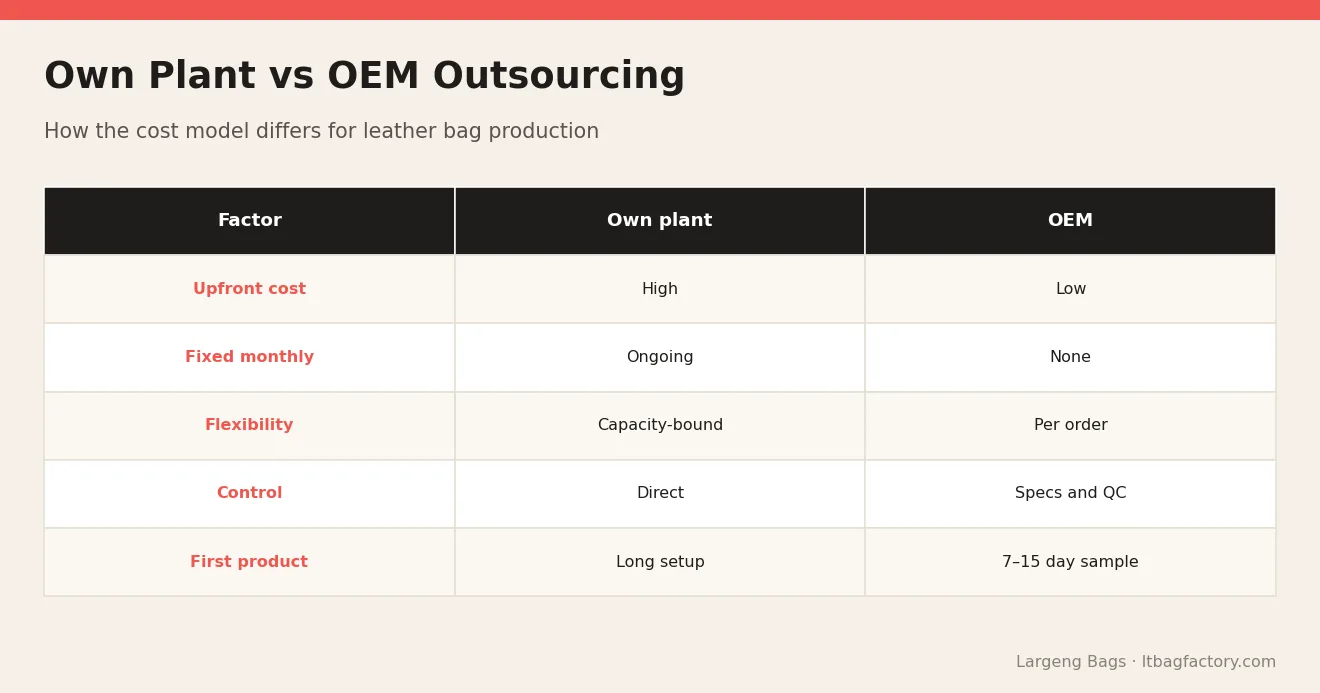
| Factor | Own plant | OEM outsourcing |
|---|---|---|
| Upfront investment | High | Low, mainly samples |
| Fixed monthly cost | Ongoing | None between orders |
| Flexibility | Tied to your capacity | Scale up or down per order |
| Control | Full, day to day | Through specs, samples and QC |
| Time to first product | Long setup period | Sampling in 7–15 days |
For a per-unit view, see how much it costs to manufacture a leather bag.
Outsourcing also gives access to a wider material range. A factory that buys leather, PU, linings and hardware for many customers can often source options that a small plant would struggle to stock.
Minimum Orders vs Minimum Utilization
Buyers often see MOQ as the main barrier to outsourcing. But an owned plant has its own minimum: it needs enough volume to keep workers busy every month. Idle capacity is often a bigger cost than a factory MOQ.
At our factory, leather bag MOQ generally starts from 100–300 pcs per style, depending on design and material, with flexible solutions for startups. Our guide to bag manufacturing MOQ explains how these numbers are set.
Seasonality makes this harder. Many bag brands sell more in certain quarters, which means an owned plant may be overloaded for part of the year and underused for the rest.
When Building Your Own Plant Can Make Sense
A plant can be the right move in some cases:
- You have steady, high volume across the year
- Your products depend on a craft technique you want to keep in-house
- You need very fast turnaround for a local market
- Made-in-your-country positioning is central to the brand
Many brands take a middle path: a small in-house workshop for samples and limited editions, with main production outsourced to an OEM factory.
Before deciding, run a simple test: add up your last year of outsourced orders, then estimate what a plant would cost to run for the same period, including idle months, training and management time.
How to Manage Quality When Outsourcing
Outsourcing does not mean giving up control. Control moves to clear specifications, approved samples and inspections. Send a tech pack, sign off a pre-production sample, and agree on inspection standards before bulk begins.
We run multi-stage quality control from raw materials to final shipment. For Quanzhou-specific capabilities, see our leather handbag manufacturer in Quanzhou page, and our leather bag manufacturing services for product scope.
Clear written standards also make it easier to switch or add suppliers later, because the specification belongs to you rather than to one factory.
Hidden Costs Brands Often Miss
When brands estimate plant cost, a few items are easy to overlook. Each one can change the comparison with outsourcing.
- Material waste: leather yield varies by hide, and learning to cut efficiently takes time.
- Minimum material purchases: leather and hardware suppliers set their own minimums, so you may hold stock you cannot use quickly.
- Machine maintenance and spare parts: presses and specialty sewing machines need regular service.
- Compliance and testing: export markets may require product testing or documentation, which takes staff time.
- Staff turnover: losing a skilled cutter or pattern maker slows production and adds training cost.
An OEM factory spreads these costs across many customers and product lines, which is one reason outsourcing is often more efficient at small and medium volumes.
Even if you plan to build your own plant later, a quotation and a sample give you a real benchmark for quality, material cost and development time.
What to Send for a Quote
If you are comparing a plant with outsourcing, a real quotation gives you a baseline. Send:
- Designs, reference photos or tech pack
- Genuine or PU leather and preferred finish
- Expected annual volume and order frequency
- Logo method and packaging needs
- Destination market
Use our contact page to share details, and our team will reply with material suggestions and a quotation.
Frequently Asked Questions
Can I start with outsourcing and move to my own plant later?
Yes, and it is a common path. Outsourcing lets you prove demand, refine designs and build supplier relationships before investing in equipment. Once volume is steady and predictable, you can compare the true running cost of a plant against your outsourcing history, which gives a much more reliable decision than early estimates. It also shows which styles justify in-house capacity.
Who owns the patterns when a factory develops my leather bag?
For OEM designs based on your tech pack, the design is yours. Pattern and die ownership should be written into your agreement, including whether the factory keeps cutting dies for reorders. Clarify this at the start so you can move production later if your plans change. Keep a copy of the pattern files for your own records.
Is genuine leather more expensive to produce than PU in a plant?
Typically yes. Genuine leather varies hide to hide, so cutting takes more skill and yields more waste. It also needs more edge finishing. PU leather comes in consistent rolls that cut more efficiently. Both require skilled labor, but genuine leather usually adds cost at the cutting and finishing stages. Leather choice therefore affects plant planning as well as unit cost.
How many product categories should a new plant handle?
A new plant usually works best with a narrow range, such as one bag type in a few materials, so workers build skill quickly. Expanding to many categories adds machines, patterns and training. Outsourcing some categories while producing a core line in-house is a practical way to manage that complexity. Specialization also keeps quality more consistent.
What should I compare besides unit price when outsourcing?
Look at sample quality, communication speed, material sourcing ability, QC process and how the factory handles reorders. A slightly higher unit price from a reliable factory often costs less overall than rework, delays or returns. Comparing these factors side by side gives a clearer picture than price alone. Ask for references on how past reorders were handled.