TL;DR: MOQ (Minimum Order Quantity) is the smallest number of units a factory will produce for a single order or style. For custom bags from China, the standard MOQ is 100–300 units per style. MOQ exists because factories have fixed setup costs per production run. You can often negotiate a lower MOQ by paying a slightly higher per-unit price or combining styles into one order.

What Is MOQ and Why Does It Exist?
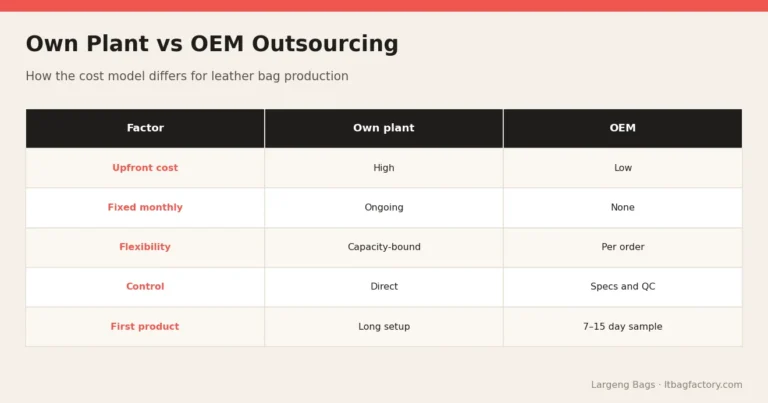
Minimum Order Quantity is the smallest production run a factory is willing to accept. It is not arbitrary — it reflects the economics of manufacturing.
Every production run, regardless of size, requires:
- Pattern making and setup time (typically 2–4 hours per style)
- Material procurement (fabric rolls, leather hides, hardware components — all have minimum purchase quantities from material suppliers)
- Machine setup and calibration
- Quality control processes
- Packaging preparation
These fixed costs are the same whether the factory produces 50 bags or 500 bags. The MOQ is the quantity at which the factory covers these fixed costs and achieves a viable profit margin.
When a brand orders fewer units than the factory’s MOQ, one of two things happens: the factory declines the order, or they accept it at a higher per-unit price (to cover the fixed costs spread over fewer units). Both outcomes are rational.
Standard MOQs by Bag Type and Customization Level
| Bag Type | ODM (Standard Style, Brand Logo Only) | OEM (Custom Design) | Fully Custom (New Pattern + Hardware) |
|---|---|---|---|
| Canvas tote | 100–200 pcs | 200–300 pcs | 300–500 pcs |
| Crossbody bag (PU) | 100–200 pcs | 200–300 pcs | 200–400 pcs |
| Structured handbag | 100–200 pcs | 150–300 pcs | 200–400 pcs |
| Backpack (nylon) | 100–300 pcs | 200–500 pcs | 300–500 pcs |
| Genuine leather bag | 50–100 pcs | 100–200 pcs | 150–300 pcs |
| Promotional tote | 200–500 pcs | 300–500 pcs | 500+ pcs |
| Wallets/small accessories | 100–300 pcs | 200–300 pcs | 300–500 pcs |
Important: These are per style, not per order. An order of 3 styles at 100 pcs each = 300 pcs total, but each style meets its own 100-pc MOQ.
How MOQ Affects Your Per-Unit Cost
MOQ and unit price are directly related. The more units you order, the lower your per-unit cost.
Example: Custom canvas tote bag
| Order Quantity | Per-Unit Factory Cost | Total Order Cost |
|---|---|---|
| 50 pcs (below MOQ, premium) | $12.00 | $600 |
| 100 pcs (MOQ) | $9.50 | $950 |
| 200 pcs | $8.20 | $1,640 |
| 500 pcs | $7.00 | $3,500 |
| 1,000 pcs | $6.20 | $6,200 |
The jump from 50 to 100 units delivers a 21% per-unit saving while adding only $350 to your total cost. The jump from 100 to 1,000 delivers a 35% per-unit saving but requires 10× the capital commitment. For most new brands, the 100–200 unit range offers the best balance of unit cost and inventory risk.
5 Strategies to Negotiate a Lower MOQ
Strategy 1: Accept a higher per-unit price. Offer to pay 10–20% more per unit to compensate the factory for reduced batch efficiency. This is the simplest and most commonly accepted approach. A factory that quotes $9.50 per unit at 100-pc MOQ may accept a 50-pc order at $11.00 per unit.
Strategy 2: Combine multiple styles into one order.r Some factories apply MOQ at the order level rather than the style level. An order of 200 units across 4 styles (50 units each) may be accepted by a factory whose stated MOQ is 200 units total. Always clarify whether MOQ is per style or per order.
Strategy 3: Start with standard colors and add a custom logo only. A bag in black with your embossed logo is simpler to produce than a bag in a custom Pantone color with custom lining. Starting with standard color options may allow a factory to accept a lower quantity because they can blend your run with other orders using the same base material.
Strategy 4: Build a long-term relationship before asking for exceptions. Factories extend lower MOQs to buyers they trust and have worked with before. If you have completed 2–3 successful orders at the standard MOQ, asking for a smaller run to test a new style is a much easier conversation.
Strategy 5: Ask explicitly — do not assume the stated MOQ is fixed. ed Many factories list a standard MOQ but have flexibility. Simply asking “We are very interested in this style but can only commit to 80 units for our first test order — is there any flexibility?” sometimes yields a yes, particularly for buyers with strong brands or clear long-term potential.
First Order Strategy: Minimizing Risk at MOQ
For your first production run with a new factory, the goal is to validate quality and market demand without overcommitting capital.
Recommended first order approach:
- Order at or just above the factory’s standard MOQ for each style (typically 100–150 units)
- Limit to 2–3 styles maximum
- Choose your most confident style as the primary order (the one you are most sure will sell)
- Use the first order to validate quality, delivery reliability, and communication — as much as to build inventory
Once you have received and inspected the first order, you will know whether to scale up the relationship. A factory that delivers on time, communicates clearly, and matches the approved sample quality is worth the investment of a larger second order.
FAQ
Q: What happens if I order 200 units and only sell 80? A: This is inventory risk, which is why starting conservatively matters. Unsold inventory ties up capital and storage space. Managing inventory risk means ordering closer to your validated demand rather than speculating on best-case scenarios.
Q: Can I mix colors within one style to meet the MOQ? A: Often yes — if you need 100 units of a crossbody bag, ordering 50 in black and 50 in tan typically meets the MOQ for the style. Always confirm with the factory, as some factories count colorways as separate SKUs.
Q: Do factories negotiate MOQ differently for repeat buyers? A: Yes. Established relationships almost always yield more flexible MOQ terms. Factories prioritize reliable, repeat buyers who pay on time and communicate professionally.
Q: What is the minimum order for samples before bulk? A: Samples are typically 1–5 units. Sample production cost is separate from bulk MOQ.
Start Your Custom Bag Journey with Largeng Bags
At Largeng Bags (ltbagfactory.com), our standard MOQ starts from 100 pieces per design. We work with emerging brands, established labels, and wholesale buyers across North America, Europe, and Australia.
- OEM and ODM services available
- Sample development: 7–15 business days
- Bulk production: 25–40 business days
- Materials: genuine leather, PU leather, canvas, nylon, rPET, plant-based alternatives
- Full OEM: custom material, color, hardware, logo, and packaging