A large capacity backpack manufacturer designs packs that carry more without failing at the seams or hurting the wearer’s shoulders. That means planning volume, fabric strength, stitching and suspension together rather than simply making a bag bigger. At our Quanzhou factory we build custom high-volume backpacks for travel, outdoor, school and work brands. This guide covers the specs that matter most, so your sample reflects real load conditions from the start.
What Counts as a Large Capacity Backpack
Buyers use “large capacity” loosely. For product planning, it helps to define it by use case rather than a single number.
| Use case | Typical contents | Key design focus |
|---|---|---|
| Travel carry-on | Clothes, laptop, toiletries | Clamshell opening, packing layout |
| Outdoor and hiking | Layers, water, food, gear | Suspension, load lifters, hip belt |
| Student and commuter | Books, laptop, lunch | Organization, padded straps |
| Work and trade | Tools, devices, documents | Reinforced base, tough fabric |
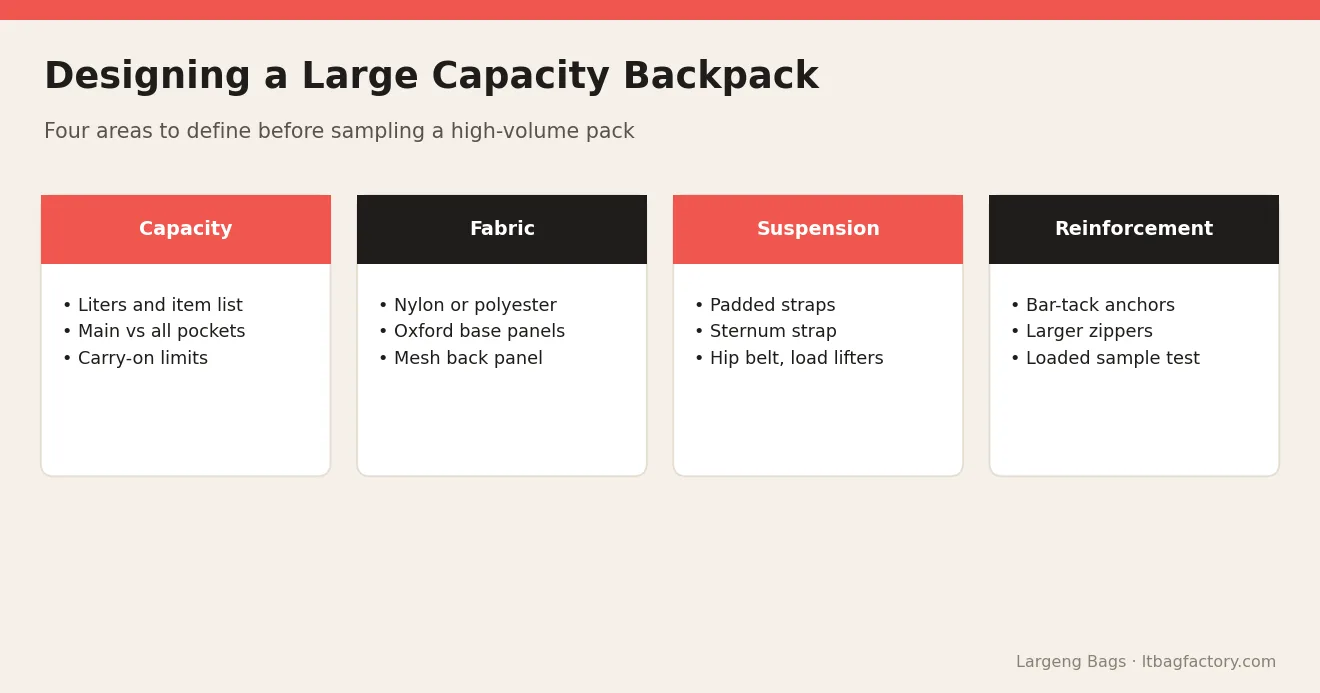
Measure capacity in liters on the sample, and list the items the bag must hold. That list is more useful to a factory than a volume figure alone.
It also helps to decide the carry pattern: will the bag be packed once and carried all day, or opened constantly? That affects where the main openings go and how much internal structure you need.
Choosing a Large Capacity Backpack Factory
A large capacity backpack factory must handle heavier fabrics, bigger panels and more reinforcement than a basic daypack line. Look for experience with padded back systems and load testing on samples.
Largeng Bags has 15+ years of bag manufacturing experience, 200+ skilled workers and a 5,000 m² facility, supplying buyers in 30+ countries. Our custom backpack manufacturing covers OEM and ODM work, from school packs to travel and outdoor styles.
- Ask for photos of similar packs the factory has produced
- Check how straps are anchored to the body
- Confirm the factory can source the fabric weight you need
- Review how they test a loaded sample
It also helps to ask whether the factory develops patterns in-house. In-house pattern makers can adjust panel shapes and strap positions quickly between sample rounds, which saves time on complex packs.
Fabric and Material Choices for Heavy Loads
Bigger bags carry more weight, so fabric choice matters more. Common options are polyester, nylon and Oxford fabric, often with a water-resistant coating, plus mesh for back panels and side pockets.
| Material | Strength | Typical role |
|---|---|---|
| Nylon | High abrasion and tear resistance | Main body on premium or outdoor packs |
| Polyester | Good, cost-effective | Main body on school and travel packs |
| Oxford fabric | Durable, easy to coat | Main body and base panels |
| Mesh | Breathable, less abrasion-resistant | Back panel, side bottle pockets |
For a fuller comparison, see canvas vs nylon vs polyester.
Fabric denier and coating should be stated on your spec sheet. Two fabrics that look similar in a photo can feel and perform very differently once the bag is loaded.
Suspension, Straps and Load Distribution
On a high-volume pack, comfort decides whether customers keep using it. Specify:
- Shoulder straps: width, foam density and curve.
- Sternum strap: keeps straps from sliding off.
- Hip belt: moves weight to the hips on larger packs.
- Load lifters: pull the load closer to the back.
- Back panel: padded foam, mesh channels or a frame sheet.
Strap anchor points are the most common failure area on heavy packs, so ask for bar-tack or box-stitch reinforcement there.
Adjustable straps should fit a range of torso lengths. If your customers vary widely in height, consider an adjustable back system or two size options rather than one fixed design.
Compartments and Access for High-Volume Packs
A large bag without structure turns into one deep hole. Good organization makes the volume usable.
Common layouts
- Clamshell main compartment that opens flat for packing
- Separate padded laptop sleeve, suspended above the base
- Bottom compartment for shoes or a jacket
- Front quick-access pocket and hidden back pocket
- Compression straps to shrink the bag when half full
Each extra zipper and pocket adds cost, so prioritize what your customer actually uses.
Water bottle pockets should fit common bottle sizes and still hold them when the bag is full. Test them on the loaded sample, because side pockets often shrink as the main compartment fills.
Stitching and Reinforcement Standards
Heavy loads stress seams, zippers and the base. Ask the factory to explain seam type, stitch density, and where binding tape or double stitching is used. Larger zippers on the main compartment usually handle strain better than small ones.
A loaded test on the pre-production sample is the best way to see how the pack behaves. Our guide to pre-production samples explains why this step should never be skipped.
The base carries the most weight and abrasion. Many brands use a heavier fabric or a double layer there, sometimes with a molded or padded bottom panel to protect contents when the bag is set down.
MOQ, Sampling and Branding
MOQ for custom backpacks depends on style, material and logo method, and is confirmed on the quotation. Samples take 7–15 days. For how quantities and timing are planned, read our OEM backpack MOQ and lead time guide.
Branding options include embroidery, screen printing, heat transfer printing, rubber patches, woven labels, metal plates and custom zipper pullers. Rubber patches and embroidery tend to wear well on outdoor packs, while printing suits large graphics on school or promo styles.
For large packs, place logos where they will not be hidden by straps or compression webbing, and check that printed areas do not crack where the fabric folds when the bag is packed.
Testing a Large Capacity Backpack Sample
A large pack should be tested full, not empty. Pack it with the item list you defined, then check the points below.
| Test | What to check | Why it matters |
|---|---|---|
| Full load carry | Strap comfort and balance | Heavy packs expose weak suspension |
| Zipper under strain | Smooth running when full | Main zippers fail first on big bags |
| Drop and set-down | Base shape and laptop protection | The base takes most impact |
| Pocket access | Pockets usable when full | Full packs squeeze pockets closed |
Note every issue with photos and measurements, and send them back together. One clear round of feedback usually gets the next sample closer than several small messages.
If you already sell a smaller backpack, tell us which features customers like and what they complain about. Real feedback is the best starting point for a larger version.
What to Send for a Quote
To quote a large capacity backpack accurately, please send:
- Target capacity and a list of items the pack must hold
- Reference photos, sketch or tech pack
- Preferred main fabric and color
- Strap, hip belt and back-panel requirements
- Logo files and branding method
- Order quantity and destination market
Share your request via our contact page, and our team will review the design and reply with suggestions and a quotation.
Frequently Asked Questions
How is backpack capacity measured on a sample?
Capacity is usually measured by filling the main compartments with small uniform material, such as foam balls, then measuring the volume in liters. Some brands count only the main compartment, others include all pockets. State which method you use so the factory builds to the same definition and your product listing stays accurate. Write the method on your spec sheet for every future reorder.
Does a larger backpack always need a hip belt?
Not always. For commuter or school packs carrying moderate loads, padded shoulder straps and a sternum strap are often enough. For travel or outdoor packs that carry heavier loads for long periods, a padded hip belt typically improves comfort by shifting weight to the hips. The right choice depends on intended use. Test both options on a loaded sample if you are unsure.
Can a large capacity backpack meet airline carry-on size limits?
It can, if you design to the target airline dimensions from the start. Carry-on limits vary by airline, so pick the strictest markets you sell to. Compression straps and a structured shape help the bag stay within limits when fully packed. Measure the loaded sample, not only the empty pattern. Soft, flexible sides help the pack fit sizers when full.
How can I reduce weight on a high-volume pack?
Use lighter fabrics on low-wear panels, keep heavier fabric for the base, and limit metal hardware. Removing rarely used pockets also helps. Each weight saving should be checked against durability on a loaded sample, since overly thin materials can fail at stress points on large bags. Lighter packs are easier to sell to travelers and commuters.
Can you add a rain cover or detachable accessories?
Yes. Rain covers, detachable pouches, bottle holders and toiletry bags can be developed to match the backpack’s fabric and branding. Accessories can be sold as a set or used as add-ons. Include them in your quote request so materials, packing and logo work are planned together with the main pack. Matching accessories also increase the value of each order.