Choosing among leather bag manufacturers in China comes down to fit: the right factory has experience with your leather type and bag style, clear sampling, a realistic MOQ and consistent quality control. China has many leather handbag factories, but capabilities vary widely. This guide explains the main factory types, what skills to check, how to judge a sample, and the questions to ask before you place a first order with a leather bag manufacturer in China.
Why Brands Source Leather Bags From China
China has a deep supply chain for bags: leather and PU suppliers, hardware makers, lining mills and packaging producers are often close to each other. That makes sampling and material changes faster than in markets where components must be imported.
Fujian and Guangdong are both well-known bag regions. Our factory is in Quanzhou, Fujian, and our page on leather handbag manufacturing in Quanzhou explains the local strengths.
Established export factories also understand international packing, labeling and documentation, which reduces friction for first-time importers. The key is finding a factory whose skills match your product rather than simply the largest one.
Types of Leather Bag Manufacturers in China
Not every supplier is a factory, and not every factory suits every buyer.
| Supplier type | Strengths | Watch for |
|---|---|---|
| Specialist leather factory | Deep leather skills | May not handle mixed materials |
| Multi-category bag factory | Leather plus textile bags, one supplier | Check leather-specific experience |
| Trading company | Wide range, easy communication | Less control over production |
| Small workshop | Very flexible | Limited QC and capacity |
Largeng Bags is a multi-category OEM and ODM factory with 15+ years of experience, making leather and PU leather bags alongside backpacks, totes and cosmetic bags.
Whichever type you choose, confirm who will be your day-to-day contact and whether that person can answer technical questions about leather, patterns and production.
Leather Handbag Factory Skills to Check
A leather handbag factory should show specific skills, not only general sewing capacity. Ask about:
- Cutting: how hides are inspected and panels laid out
- Skiving: thinning edges for clean folds and seams
- Edge finishing: painted, folded or raw edges
- Stitching: stitch density and thread choice
- Hardware: sourcing and plating finishes
- Logo work: debossing, embossing, metal plates
Request close-up photos of edges and stitching on past work. These details reveal more than product shots.
Also ask what leather types the factory works with most. A factory that mainly produces soft PU fashion bags may need time to adjust to firm vegetable-tanned leather, and the reverse is also true.
Ask how the factory handles leather defects found after cutting. A clear process for replacing flawed panels shows that quality is managed before problems reach the sewing line.
How to Evaluate a Leather Bag Manufacturer in China
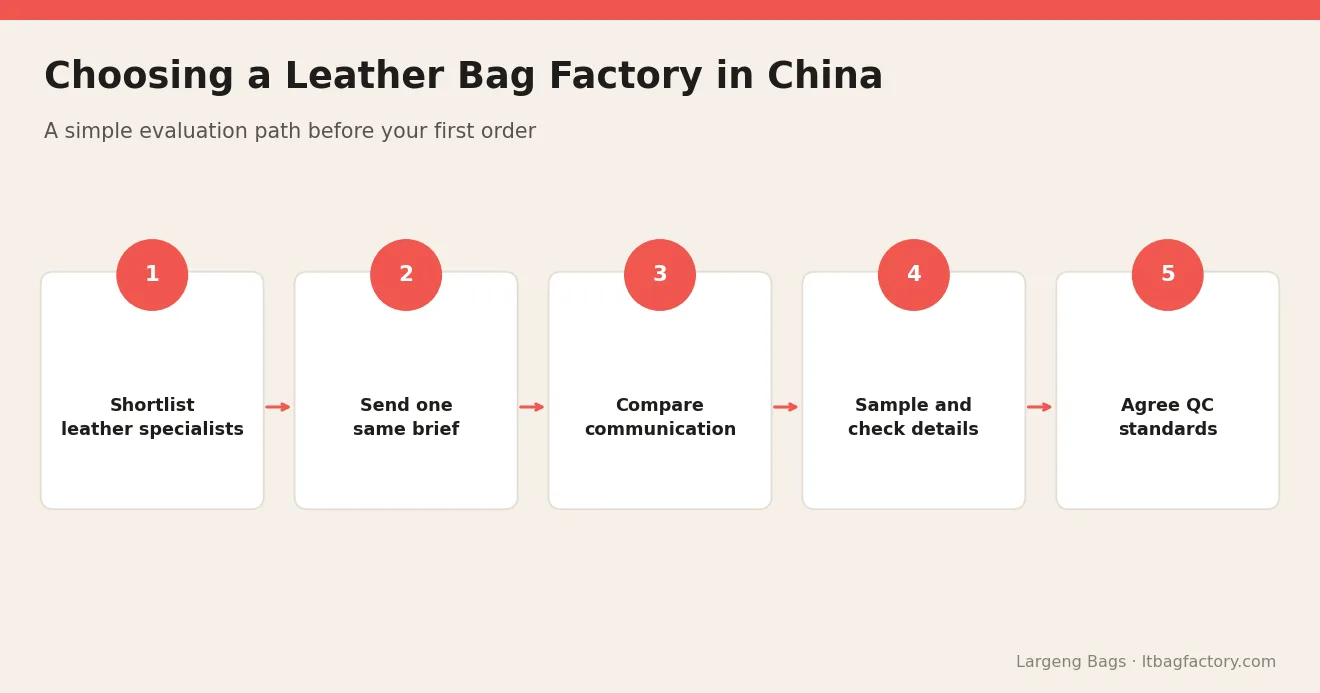
Use a structured process instead of choosing on price alone:
- Shortlist suppliers with relevant leather products
- Share the same brief with each so quotes are comparable
- Check communication: speed, clarity and questions asked
- Order samples and compare them side by side
- Review quality control steps and inspection options
Our China bag manufacturer buyer checklist covers the vetting questions in more detail.
Pay attention to the questions a supplier asks you. A factory that asks about leather thickness, edge finish and hardware plating is usually thinking about how to build your bag correctly, not just how to win the order.
Judging a Leather Bag Sample
A sample shows what a factory can actually do. Check it against your specification point by point.
| Area | What good looks like | Red flags |
|---|---|---|
| Edges | Even paint, smooth, no cracks | Uneven, sticky or peeling |
| Stitching | Straight, even spacing | Skipped or loose stitches |
| Leather | Consistent color, no marks on front | Scratches on visible panels |
| Hardware | Smooth zips, secure fixing | Rough zips, loose rivets |
| Shape | Holds form when empty | Collapses or twists |
Samples at our factory take 7–15 days depending on complexity.
Compare samples from different suppliers in the same light and on the same day. Small differences in edge finish and stitching are easier to see side by side than from memory.
MOQ and Order Planning
Leather bag MOQ in China varies by factory, design and material. At our factory, leather bag MOQ generally starts from 100–300 pcs per style, with flexible options for startups. Genuine leather in a custom color usually needs more planning than stock PU colors.
Bulk lead time, payment terms and shipping terms are confirmed on the quotation. If you are launching a brand, our private label handbag manufacturer page explains how we support new labels.
It also helps to plan your first order around one or two core styles rather than a large collection. That keeps quantities per style higher and gives you a clear test of the factory before you expand.
Ask how the factory handles reorders as well. Keeping patterns, dies and approved materials on record means a repeat order can start faster and match the first batch more closely.
Quality Control Before Shipment
Agree on quality standards before bulk production starts. Many buyers use the approved sample as the reference and define acceptable defect levels in writing.
We apply multi-stage quality control from raw materials through final shipment. For a buyer-side inspection checklist, read our pre-shipment inspection guide, and see our leather bag manufacturing overview for materials and product types.
Keep the approved sample sealed and labeled, with a matching sample held at the factory. Both sides can then compare bulk goods against the same physical reference instead of photos alone.
Discuss how defects found at inspection will be handled, whether by rework, replacement or another agreed solution, so both sides know the process before goods are packed.
Communication and Working Style
Leather bags involve many small decisions, so communication often matters as much as production skill. Look for a supplier that responds clearly and keeps records of every change.
| Signal | Good sign | Warning sign |
|---|---|---|
| Response to brief | Specific questions about details | Instant quote with no questions |
| Change tracking | Updated spec sheet after each change | Changes only in chat messages |
| Problem reporting | Raises issues before production | Issues found only at inspection |
| Photos and updates | Progress photos at key stages | No visibility until shipment |
A factory with a steady working style makes reorders easier too, because materials, patterns and standards are already recorded from the first order.
If you are still comparing suppliers, mention your timeline and any fixed launch dates so we can tell you early whether the plan is realistic.
We reply with questions where details are missing, so the quotation reflects the bag you actually want rather than a rough estimate.
What to Send for a Quote
A clear first message helps any leather bag manufacturer in China quote accurately. Include:
- Reference photos, sketch or tech pack
- Genuine or PU leather and color
- Hardware finish preferences
- Logo method and packaging needs
- Target quantity per style
Send your brief through our contact page and our team will reply with questions, suggestions and a quotation.
Frequently Asked Questions
How can I tell if a supplier is a factory or a trading company?
Ask for factory photos and videos of production lines, and request a live video call walking the floor. A factory can usually explain cutting, sewing and QC steps in detail and show work in progress. Trading companies can still be useful, but you should know who actually makes your bags. Also ask how long the factory has made leather bags.
Can I visit a leather bag factory in China before ordering?
Many factories welcome visits, and seeing production helps build trust. If travel is not practical, a video tour or a third-party inspection can cover similar ground. Plan visits around sampling or production stages so you can see your own product being made, not only a showroom. A visit during bulk production shows real working conditions.
Should I send my own leather or let the factory source it?
Most buyers let the factory source leather because it has supplier relationships and knows what works on its machines. If you require a specific leather, you can supply it, but confirm shipping, storage and wastage allowances first. Either way, approve leather swatches before sampling. Written approval of swatches avoids later disputes over color.
How many factories should I sample with?
Two or three is a practical number for most brands. It gives enough comparison without spreading development effort too thin. Send each the same brief, compare samples side by side, and weigh communication and responsiveness alongside quality, since those shape the whole production relationship. Keep notes on each supplier so the comparison stays objective.
What language and file formats work best with Chinese factories?
English is standard for export factories. Clear visuals help most: sketches with dimensions, labeled photos and vector logo files such as AI or PDF. Keep one updated specification document and note every change with a date, so both sides always work from the same version. Consistent files reduce errors on samples and bulk goods.