A leather backpack manufacturer turns your design, or one of its own ODM styles, into genuine or PU leather backpacks and computer bags under your brand. The main decisions are leather type, laptop protection, hardware and logo method, and they shape both cost and MOQ. Leather bag MOQ at our Quanzhou factory generally starts from 100–300 pcs per style, and samples take 7–15 days. This guide explains what to specify so your first sample is close to right.
What a Leather Backpack Manufacturer Actually Does
Leather bag manufacturing is different from sewing textile backpacks. Leather panels are cut piece by piece around natural marks, edges are skived, painted or folded, and stitching has to hold without tearing the hide. A specialist factory manages all of that alongside the usual backpack work: padding, lining, straps and compartments.
At Largeng Bags we have 15+ years of bag manufacturing experience, 200+ skilled workers and a 5,000 m² facility in Quanzhou. Leather and PU leather backpacks are made next to our wider leather bag manufacturing line, so the same cutting, edge-finishing and QC teams handle both handbags and backpacks.
Typical services include:
- Pattern making from your tech pack, sketch or reference bag
- Leather and hardware sourcing to your target quality
- Logo application: embossing-style debossing, metal plates, woven labels, embroidery on fabric parts
- Sampling, bulk production and multi-stage quality control
Genuine Leather vs PU Leather for Backpacks
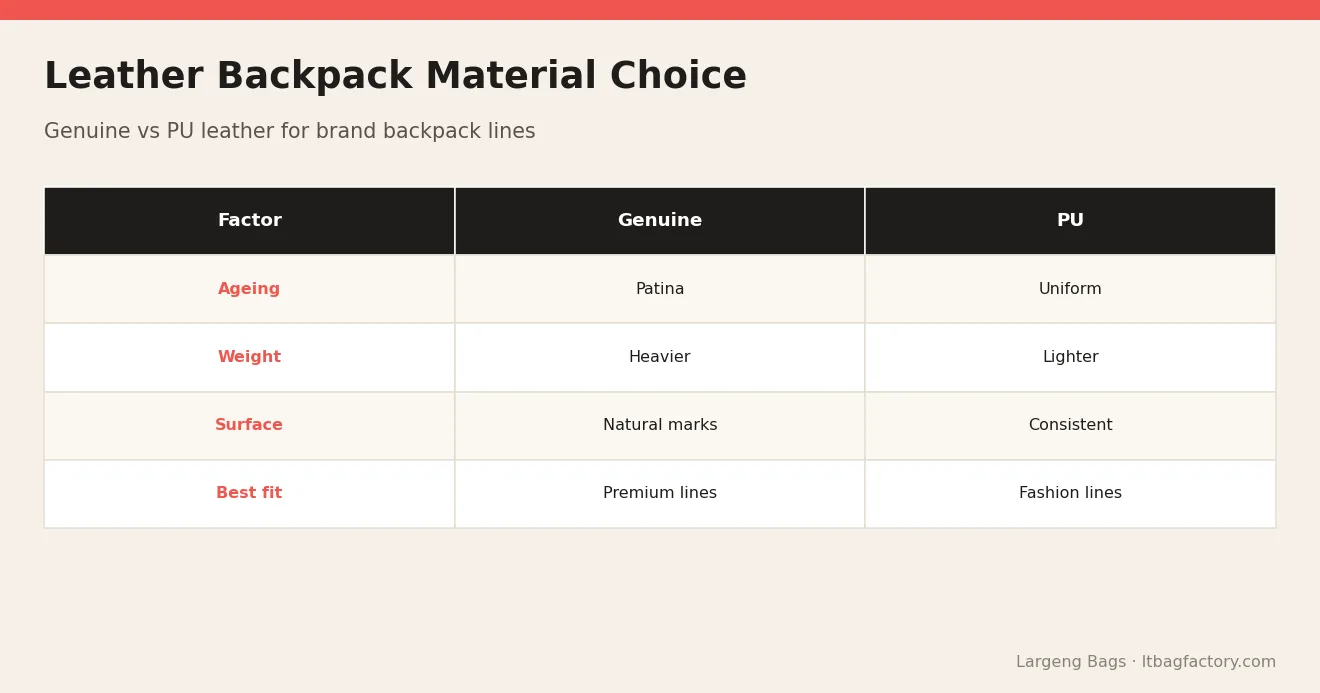
The first choice is the material. Genuine leather ages well and suits premium lines. PU leather gives a consistent surface, lighter weight and easier cleaning, and it often suits fashion or vegan-positioned collections.
| Factor | Genuine leather | PU leather |
|---|---|---|
| Look over time | Develops patina | Stays uniform |
| Weight | Heavier on large packs | Usually lighter |
| Surface consistency | Natural marks, varies by hide | Very consistent roll to roll |
| Water resistance | Depends on finish | Generally good on the surface |
| Best fit | Premium, heritage, gift lines | Fashion, student, vegan-positioned lines |
For a deeper comparison, including vegan alternatives, read our genuine vs PU vs vegan leather guide.
Leather thickness also matters on backpacks. Thicker leather holds shape and resists wear on the base and straps, while thinner leather keeps the pack light and flexible. Many brands use thicker leather for load-bearing parts and thinner leather for pocket fronts and flaps.
ODM Leather Backpack and Computer Bag Supplier Options
Many buyers search for an ODM leather backpack computer bag supplier because ODM shortens development. You pick an existing factory design, then change the leather, color, lining, hardware and logo. OEM means we build your own design from scratch.
| Route | What you provide | Best when |
|---|---|---|
| ODM | Chosen base style plus changes | You need a faster start or are testing a market |
| OEM | Full design or tech pack | You want a signature silhouette |
| Hybrid | Base style plus new pockets or shape edits | You want a distinct look with less risk |
ODM styles still carry your branding and packaging. The difference is who owns the original pattern, which is worth clarifying before you plan exclusivity.
Laptop and Computer Bag Specifications
A leather computer backpack must protect a device, not just carry it. Define these points early:
- Laptop size: give the device dimensions, not just the screen size, because bodies vary between models.
- Padding: foam thickness for the laptop sleeve and the back panel.
- Suspended sleeve: a sleeve that sits above the base protects the corners if the bag is dropped.
- Access: top opening, side zip or clamshell opening for travel checks.
- Organization: tablet, pen and cable pockets, plus a key clip.
Heavy devices put strain on shoulder strap joints, so ask how those points are reinforced on the sample.
If you sell in several markets, check the laptop sizes most common there. A sleeve that fits one generation of devices may be tight for the next, so a little extra room is often worth it.
Hardware, Lining and Construction Details
Hardware is where premium leather backpacks are often judged. Zippers, buckles, D-rings and strap adjusters should match the leather in weight and finish. Our bag hardware guide lists what to specify.
Construction points to confirm
- Edge finish: painted, folded or raw
- Stitch type and thread color
- Lining fabric and whether it carries a printed logo
- Base reinforcement and whether metal feet are added
- Strap padding and back-panel breathability
Each choice adds labor or material, so decide what the customer will actually notice.
Ask for the sample to be made with the exact hardware finish planned for bulk. Swapping hardware after approval is a common source of color mismatch between the sample and the final shipment.
Logo and Branding Options on Leather
Leather takes branding differently from fabric. Common methods on leather backpacks include debossed or embossed logos, metal plates, and branded zipper pullers. On fabric areas such as linings or straps, woven labels, embroidery and printing work well.
Hang tags, dust bags and retail packaging complete the private label presentation. If you sell through retail, confirm barcode labels and carton marks at the quotation stage so packing is correct from the first shipment.
Debossing works well on vegetable-tanned and firm leathers, while soft or heavily textured leathers may show a logo less clearly. Test your logo size on a leather swatch before the full sample is made.
Keep logo placement consistent across every style in the line so the brand is recognized at a glance.
MOQ, Sampling and Production Planning
For leather bags, MOQ generally starts from 100–300 pcs per style, depending on the design and material. Genuine leather in special colors can require a higher starting quantity than stock PU colors. We offer flexible solutions for startups, such as fewer color options on the first run.
Samples take 7–15 days. Bulk lead time, payment terms and shipping terms are confirmed on the quotation because they depend on material availability and order size. For broader backpack timing, see our backpack manufacturer page.
Common Leather Backpack Styles for Brands
Most leather backpack lines are built from a handful of proven silhouettes. Choosing one as a starting point makes ODM development faster.
- Flap backpack: classic look with buckle or magnetic closures, suited to heritage and gift lines.
- Zip-top commuter pack: clean profile, laptop sleeve and front pocket for office use.
- Roll-top pack: adjustable volume and a modern outdoor-inspired look.
- Convertible backpack: switches between backpack and shoulder bag with detachable straps.
- Mini backpack: fashion-led, often in PU leather with bright colors.
Share which style your customers already buy, then decide where your version should differ: material, organization, hardware or size.
What to Send for a Quote
A complete request gets a faster and more accurate quote. Please include:
- Reference photos, sketch or tech pack
- Genuine or PU leather, plus preferred color
- Laptop size and padding needs
- Logo files and preferred branding method
- Target quantity per style and color
- Destination market and packing needs
Send these details through our contact page and our team will reply with material suggestions and a quotation.
Frequently Asked Questions
Can a leather backpack combine genuine leather with canvas or nylon?
Yes. Mixed-material backpacks are common. Leather is often used for the flap, base, straps and trims, while canvas or nylon forms the main body. This keeps the premium look, reduces weight and can lower material cost. Confirm how the materials are joined and how the leather edges are finished before sampling. Share a photo of the look you want so the balance is right.
How do you check leather quality before cutting?
Hides are inspected for marks, thickness and color before cutting, and panels are laid out to avoid visible flaws on the front. PU leather rolls are checked for surface defects and color consistency. Quality control continues through sewing and final inspection before packing, so issues are caught before shipment. Buyers can also request photos of cut panels before sewing.
Is PU leather suitable for a daily-use computer backpack?
Often, yes. Good PU leather resists surface water, cleans easily and keeps a uniform look. Durability depends on the base fabric and coating thickness, so ask to see material swatches and test the sample under real load, especially at strap joints and the base where abrasion is highest. A short carry test with a real laptop inside is worth doing.
Can I order several colors within one leather backpack style?
Usually yes, but each color typically has its own starting quantity because the leather is bought and cut per color. Startups often launch with one or two colors, then add more once sales are proven. The exact split is confirmed on the quotation based on material availability. Plan the color split before ordering leather.
Do you make matching leather accessories for a backpack line?
We can develop matching items such as pouches, wallets-style organizers, laptop sleeves or tote bags in the same leather and hardware. Keeping materials consistent across a collection simplifies sourcing and gives the line a unified look. Share the full product list early so materials can be planned together. Matching sets also make retail displays and gift bundles easier.