For OEM ODM backpack wholesale, the difference is who provides the design. With OEM, you supply the design and the factory builds it to your specification. With ODM, you choose an existing factory design and customize it with your colors, materials and logo. OEM gives more control and uniqueness; ODM is usually faster and simpler to develop. This guide explains when each route fits, based on our work as a backpack factory in Quanzhou, China.
OEM and ODM in Plain Terms
OEM (original equipment manufacturing) means the factory produces your design. You provide the concept, often through a tech pack, and the factory handles pattern making, sampling and production.
ODM (original design manufacturing) means the factory has already developed the design. You select a model and adjust it within agreed limits: colors, fabrics, trims and branding. The core pattern stays the same.
Many projects sit in between. A buyer may start with an ODM backpack and change pockets or straps, which moves it closer to OEM.
In the wholesale backpack market the terms are sometimes used loosely. A supplier listed as OEM may also offer its own catalog, and an ODM supplier may accept custom designs. Ask directly how each route works at that factory rather than relying on the label.
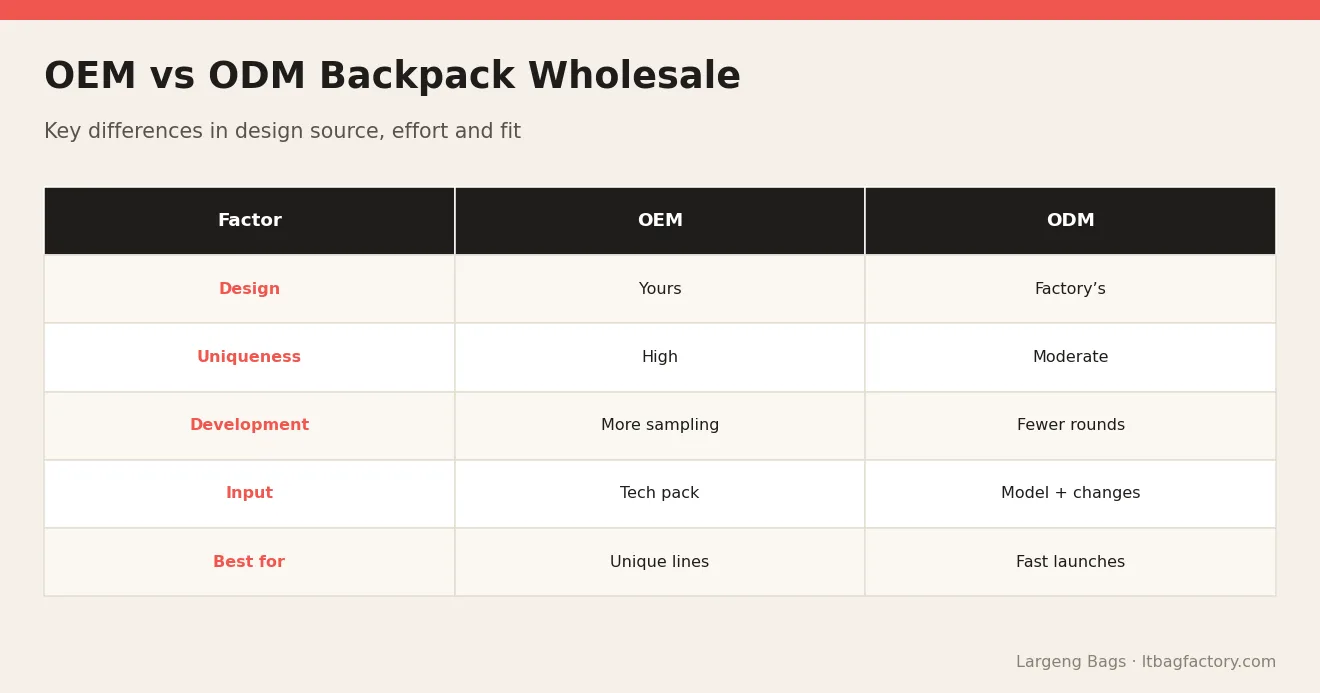
OEM vs ODM Backpack Wholesale Compared
| Factor | OEM | ODM |
|---|---|---|
| Design source | Buyer | Factory |
| Uniqueness | High, fully your own | Moderate, shared base design |
| Development effort | More sample rounds likely | Fewer, pattern already proven |
| Input needed | Tech pack or detailed brief | Model choice plus customization list |
| Minimum quantity | Depends on design and materials | Often more flexible on stock materials |
| Best for | Established brands, unique products | New lines, retailers, fast launches |
Both routes can use the same logo methods, materials and packing. The difference is mostly in design ownership and development time.
In practice, the right route often depends on your timeline and how much product development your team can manage. If you have a clear design and time to refine it, OEM pays off. If speed and lower development effort matter more, ODM is usually the practical start.
When to Choose an OEM Backpack Manufacturer
Working with an OEM backpack manufacturer makes sense when the design itself is part of your brand value.
- You have a distinctive design or signature feature
- You need specific dimensions, such as for a laptop or equipment
- You want a product line that competitors cannot easily buy
- You already have a tech pack or an in-house designer
If you are building your first tech pack, our guide on how to read a bag tech pack explains what each page should cover.
OEM also gives you full control over the bill of materials. You can specify exactly which fabric, zipper and buckle grades are used, which helps when you need consistent quality across several product lines or repeat seasons.
When ODM Is the Better Fit
ODM suits buyers who need a proven product quickly or who are testing a category. Retailers, promotional buyers and startups often start here.
- You need a reliable backpack for a season or promotion
- You want to test demand before investing in a unique design
- Your brand value is in the logo, color and packaging
- You prefer fewer sample rounds
Ask the factory which parts of an ODM design can be changed. Colors, fabrics, logo and labels are usually flexible; changing the shape may turn it into an OEM project.
ODM also reduces risk for buyers new to backpacks. Because the factory has already produced the model, fit, pocket sizes and strap comfort have usually been tested, and fewer surprises appear during bulk production.
Customization Options in Both Routes
Whichever route you choose, most branding and finishing options are the same.
| Area | Common options |
|---|---|
| Fabric | Polyester, nylon, Oxford, canvas, PU leather |
| Logo | Screen print, heat transfer, embroidery, rubber patch, woven label, metal plate |
| Hardware | Zipper type, custom pullers, buckles, webbing color |
| Inside | Laptop sleeve, organizer pockets, lining color |
| Packing | Polybag, hang tag, printed box, carton marks |
Browse our backpack manufacturer page for backpack types that can be adapted as ODM or used as references for OEM.
MOQ and Cost Factors
MOQ depends on style, material and logo method, and is confirmed on the quotation. In general terms, custom-dyed fabrics, custom webbing or molded parts raise the minimum, while stock materials help keep it flexible. Our guide to bag manufacturing MOQ explains why.
Unit cost is shaped by fabric, construction complexity, hardware, logo method and quantity. OEM projects may carry extra development effort in sampling. For backpack-specific minimums and timing, see OEM backpack MOQ and lead time.
Whichever route you choose, ask for quotes at two or three quantity levels. This shows how unit cost changes with volume and helps you decide on a sensible first order size without overcommitting.
Design Ownership and Exclusivity
With OEM, the design is yours; agree in writing that the factory will not sell it to others. With ODM, the base design may be offered to other buyers, although your colors, logo and packaging remain your own.
If exclusivity on an ODM model matters, discuss it before ordering. Some changes to the design can make it distinct enough for your line. Keep records of your specifications, approved samples and correspondence.
A Hybrid Route: Modified ODM
Many OEM ODM backpack wholesale projects end up as a hybrid. The buyer starts from a factory model and changes a few functional details, such as adding a laptop sleeve, moving a bottle pocket or changing strap padding. This keeps much of the speed of ODM while giving the product more individuality.
- Choose an ODM model close to your target design
- List the changes: pockets, straps, dimensions, materials
- Ask the factory which changes need new patterns
- Approve a revised sample before bulk
- Record the final specification as your own version
The more changes you make, the closer the project moves to OEM in terms of sampling effort. Keeping the core pattern and changing only visible details is usually the most efficient approach for a first order.
| Change | Effect on development |
|---|---|
| Color, logo, labels | Minimal, usually no new pattern |
| Fabric or lining swap | Low, check fit and stiffness |
| New pocket or sleeve | Moderate, pattern update needed |
| New body shape or harness | High, effectively an OEM project |
Before bulk starts, confirm the final specification in writing, including approved sample photos, material codes and logo sizes. This single reference protects both OEM and ODM projects when questions come up during production or reorders.
What to Send for a Quote
Whether you choose OEM or ODM, contact our team with the following.
- Route: OEM with your design, or ODM with a model reference
- Tech pack, sketch or reference images
- Materials, colors and hardware preferences
- Logo method, artwork and placement
- Quantity per style and color
- Packing needs and destination market
Samples are made within 7–15 days. Bulk lead time is confirmed on the quotation.
Frequently Asked Questions
Can I start with ODM and move to OEM later?
Yes, and many brands do. Starting with an ODM backpack lets you test demand with lower development effort. Once you learn what customers want, you can develop an OEM design with your own features. Feedback from the first order often shapes the second design.
Is OEM always more expensive than ODM?
Not always. OEM can involve more sampling and pattern work, but the unit cost depends mainly on materials, construction and quantity. A simple OEM design may cost less than a complex ODM model. Compare quotes on the same materials, logo method and packing for a fair view.
How much can I change an ODM backpack?
Colors, fabrics, lining, logo, labels, zipper pullers and packaging are usually flexible. Changes to the body shape, pocket layout or strap system may require a new pattern, which makes the project closer to OEM. Share your list of changes, and the factory will say which route applies.
Do I need my own designer for OEM?
Not necessarily. You need a clear description of what you want, such as sketches, reference images, dimensions and feature lists. Some factories help turn that into a working specification and sample. A designer helps for complex products, but many brands start with a detailed brief.
Which route is better for promotional backpacks?
ODM is often the practical choice for promotions because the design is proven and development is quick. You add your logo, colors and packaging. OEM makes more sense when the backpack itself must be distinctive, such as a branded product line rather than a one-time giveaway.