Choosing a cosmetic bag manufacturer in the USA or China comes down to trade-offs. US production typically offers shorter transit, easier communication and “Made in USA” positioning, while China usually offers a wider material range, deeper supply chains and more competitive unit costs at scale. The right choice depends on your quantity, price point and timeline. This guide compares both options honestly, from the view of a Quanzhou OEM factory.
Cosmetic Bag Manufacturer USA vs China: The Short Answer
If you need small quantities quickly for a domestic market and your retail price supports higher labor costs, a US workshop can be a good fit. If you need custom materials, multiple styles, retail packaging and competitive unit costs, a China factory is usually the stronger option.
Many brands do not choose one forever. They sample or test locally and scale overseas, or the reverse.
The decision is rarely only about unit price. Brand positioning, cash flow, storage space, how often you restock and how much control you need over materials all shape which option fits. The sections below look at each factor in turn.
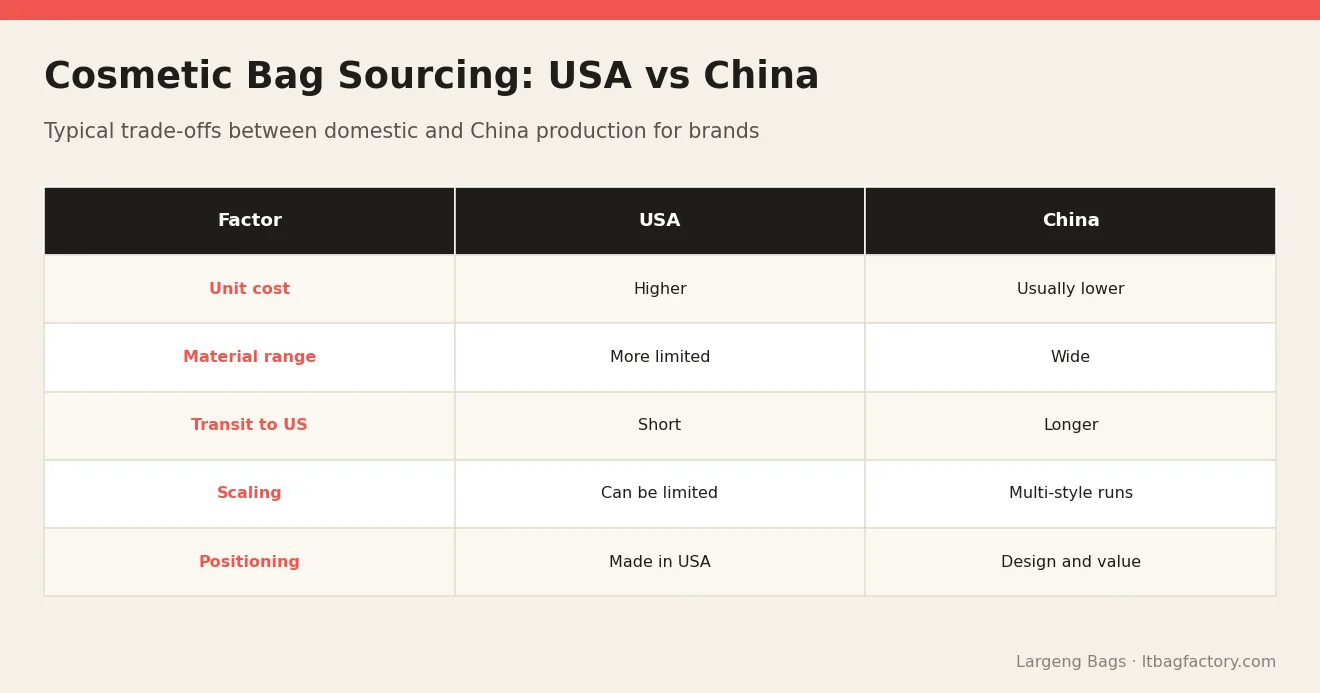
Side-by-Side Comparison
| Factor | USA production (typical) | China production (typical) |
|---|---|---|
| Unit cost | Higher, driven by labor costs | Usually lower, especially at scale |
| MOQ | Small runs often possible | Varies by factory; flexible options exist |
| Material and trim range | More limited locally | Wide range close to the factory |
| Transit to US customers | Short, domestic | Longer; sea or air freight |
| Communication | Same language and time zone | Needs clear specs and time zone planning |
| Positioning | “Made in USA” claim possible | Focus on design and value |
These are general patterns. Individual suppliers in both countries vary widely.
When comparing suppliers, request quotes on the same specification from each side. Differences in material grade, packing or logo method can make two quotes look far apart when the bags are not actually comparable.
When a Cosmetic Bags Manufacturer in the USA Makes Sense
- Very small test runs where freight and import steps outweigh savings
- Products marketed specifically as made in the USA
- Urgent reorders for a domestic launch
- Designs that need frequent in-person fittings or changes
- Brands with a retail price that absorbs higher labor costs
Buyers should still check capacity. Many US cut-and-sew workshops are small, and scaling to larger orders or several styles can be difficult.
Before committing, ask a domestic workshop about its material sources, maximum weekly output and ability to handle retail packaging. These details show quickly whether the supplier can grow with your brand.
When China Production Makes More Sense
China’s bag clusters, including Quanzhou, have material suppliers, zipper makers, printers and packaging vendors close together. That shortens sourcing for custom fabrics, PU leather, PVC and hardware.
Our factory has 15+ years of bag manufacturing experience, 200+ skilled workers and a 5,000 m² facility, and serves buyers in 30+ countries. Our cosmetic bag manufacturing service covers OEM and ODM development, logo work and retail packaging under one roof. Use our China bag manufacturer buyer checklist to vet any supplier.
A US supplier may also source materials from overseas, so ask where fabrics, zippers and trims originate. Material availability can affect both lead time and the accuracy of any origin claim on your packaging.
If local production is a brand pillar, verify capacity for your planned reorder volumes before committing a full product line to one workshop.
Branding and packaging can be handled in the same place as production. Screen printing, heat transfer printing, embroidery, rubber patches, woven labels, metal plates, hang tags and retail packaging are all arranged alongside sewing, so bags arrive retail-ready rather than needing a second supplier for finishing.
MOQ and Flexibility Compared
| Brand stage | US option | China option |
|---|---|---|
| Concept testing | Small local batch | ODM pattern with logo change |
| First launch | Limited styles and colors | Custom materials, several colorways |
| Scaling | Capacity may limit growth | Larger runs across multiple styles |
MOQ in China depends on style, material and logo method, and many factories offer startup-friendly options. See our overview of low MOQ custom bags.
Speed of development is another factor. Because materials, zippers, printing and packaging are all sourced nearby, sampling rounds in a Quanzhou factory can move quickly once the specification is clear. Sample production at our facility takes 7–15 days depending on design and material sourcing.
Lead Time, Shipping and Landed Cost
Domestic production avoids ocean transit and customs steps, which is its clearest advantage. Overseas production adds freight, duties and import handling to the unit price, so compare landed cost rather than factory price alone.
Sample production at our factory takes 7–15 days. Bulk lead time and shipping terms are confirmed on the quotation according to your order. Our custom bag production timeline explains how to plan around each stage.
Cash flow is part of the equation. Larger overseas orders can tie up more capital in stock, while smaller domestic runs may cost more per unit but free up funds. Planning reorders early lets you use sea freight and avoid expensive rush shipments.
Hybrid Sourcing Models
Some brands produce core, high-volume styles overseas and keep small urgent runs or limited editions local. Others sample in China, validate the design with customers, then plan larger orders.
A hybrid model works best when the specification is documented well, so both suppliers build to the same standard.
To make a hybrid approach work, keep one master tech pack, approved material references and a shared quality checklist. Assign one person on your team to manage both suppliers, so changes are recorded once and applied everywhere.
Hybrid sourcing also spreads risk. If one supplier faces a capacity crunch or a material shortage, the other can cover urgent needs while the main order continues.
Quality Control in Either Country
Quality depends on the supplier and the process, not the country. Well-run workshops exist in both the USA and China, and so do weak ones. What matters is how clearly quality is defined and checked.
Controls to agree with any manufacturer
- Approved materials and color swatches kept as references
- A signed-off pre-production sample for every style
- Inline checks on stitching, zippers and logo placement
- Final inspection against an agreed checklist before shipment
- Clear handling of defects and replacements
We apply multi-stage quality control from raw materials to final shipment, and buyers are welcome to arrange third-party inspections. Our pre-shipment inspection checklist is a useful starting point whichever country you source from.
If you already work with a local supplier, sending the same specification to us lets you compare like for like. We will highlight any differences in materials or construction in our reply.
What to Send for a Quote
The faster we understand your project, the faster you receive an accurate quotation. Please include as much of the following as you can:
- Design, dimensions and reference images
- Materials, colors and logo method
- Quantity per style and planned reorder frequency
- Destination and preferred shipping method
- Target launch date
Get in touch with our team to compare our quotation with your local options.
Frequently Asked Questions
Can a China factory ship directly to my US warehouse or Amazon?
Yes, shipping to a US warehouse or fulfilment center is common. The exact arrangement, including shipping method, responsibility for import clearance and labeling requirements, is agreed during quotation. Share your delivery address type and any carton labeling rules so packing is prepared correctly from the start.
How do I protect my design when manufacturing in China?
Common steps include working with a factory that signs a confidentiality agreement, registering trademarks in your key markets, and keeping tech packs and artwork files controlled. Buyers often also apply for design protection where available. Clear written agreements on ownership of patterns and molds help avoid misunderstandings.
Is communication difficult with overseas bag factories?
It depends on the supplier. Factories used to exporting usually have English-speaking sales and project staff. Clear written specifications, photos, measured sketches and approval of physical samples reduce misunderstandings more than anything else. Agree on response times early, allowing for the time difference between your office and the factory.
Can I visit the factory or arrange an inspection?
Yes. Buyers can visit in person, send an agent or book third-party inspections at different production stages. Pre-production samples and pre-shipment inspections are the most common checkpoints. Let us know your preferred inspection plan during quotation so the schedule accommodates it.
Are import duties included in a China factory quote?
Usually not. Factory quotations are commonly given on terms such as FOB, with duties and import costs paid by the buyer, although delivered terms can be arranged. Duty rates depend on the product classification and your country. Confirm the terms stated on the quotation and check duty rates with your customs broker.