Last updated: April 2026
In early 2025, a Philadelphia-based designer named Jen Risk began making a bag by hand. Each one took over 10 hours. She called it the Boatkin — a portmanteau of the iconic Birkin bag and L.L. Bean’s classic Boat and Tote.
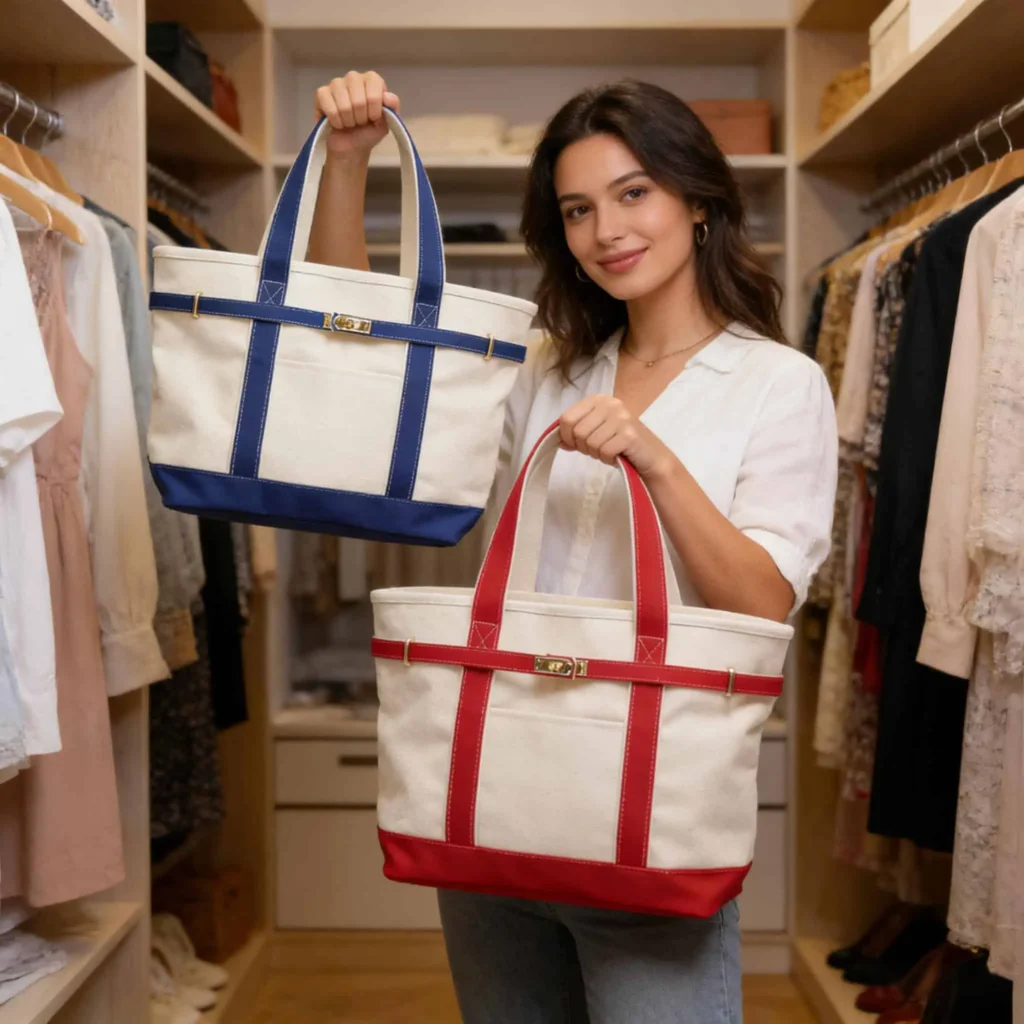
The bag went viral almost immediately.
It landed on Good Morning America. It was featured in People magazine. The New York Times Style section ran a feature headlined “The Birkin Inspires Yet Another Homage.” Risk had pre-sold 300 bags and built a growing waitlist before the ink was dry.
Then, just as suddenly as it appeared, the Boatkin vanished.
Hathaway Hutton’s Instagram was scrubbed of almost all Boatkin references. The product pages disappeared. The bag was replaced by a similar-but-different style called the “Birdie.” Fashion Law journalists noted the obvious implication: a quiet cease-and-desist, likely from Hermès, whose Birkin silhouette the Boatkin closely referenced.
The original Boatkin is gone. But the demand it created isn’t.
What the Boatkin Actually Was (And Why It Resonated)
Understanding why the Boatkin went viral is essential to understanding the manufacturing opportunity it left behind.
The bag combined two distinct design languages:
From the Birkin:
- Structured, boxy body with a flat base
- Rolled top handles
- Visible turn-lock or clasp hardware at the top
- Trapezoidal silhouette — wider at the base than the top
From the L.L. Bean Boat and Tote:
- Heavy canvas construction
- Contrast handles in a different color
- Open or simple-closure top
- Rugged, utilitarian aesthetic
The result was described as “quiet luxury with a smirk” — a phrase that perfectly captures why it worked. It had the structured elegance of a \$12,000 Birkin, the approachable casualness of a \$40 canvas tote, and just enough tongue-in-cheek self-awareness to feel genuinely clever rather than merely aspirational.
The Boatkin also hit a precise price-to-market sweet spot that the fashion world rarely sees: it was expensive enough to feel special (\$1,200–\$1,600), but the design narrative made it feel like a smart choice rather than a luxury splurge.
The Gap the Boatkin Left Behind
When the original Boatkin disappeared, two things happened simultaneously:
1. Demand didn’t disappear with it.
The viral coverage continued to drive search traffic. People who discovered the Boatkin after its disappearance couldn’t find the original, so they searched for alternatives. “Boatkin bag” continues to generate meaningful search volume.
2. The market is filled with imperfect alternatives.
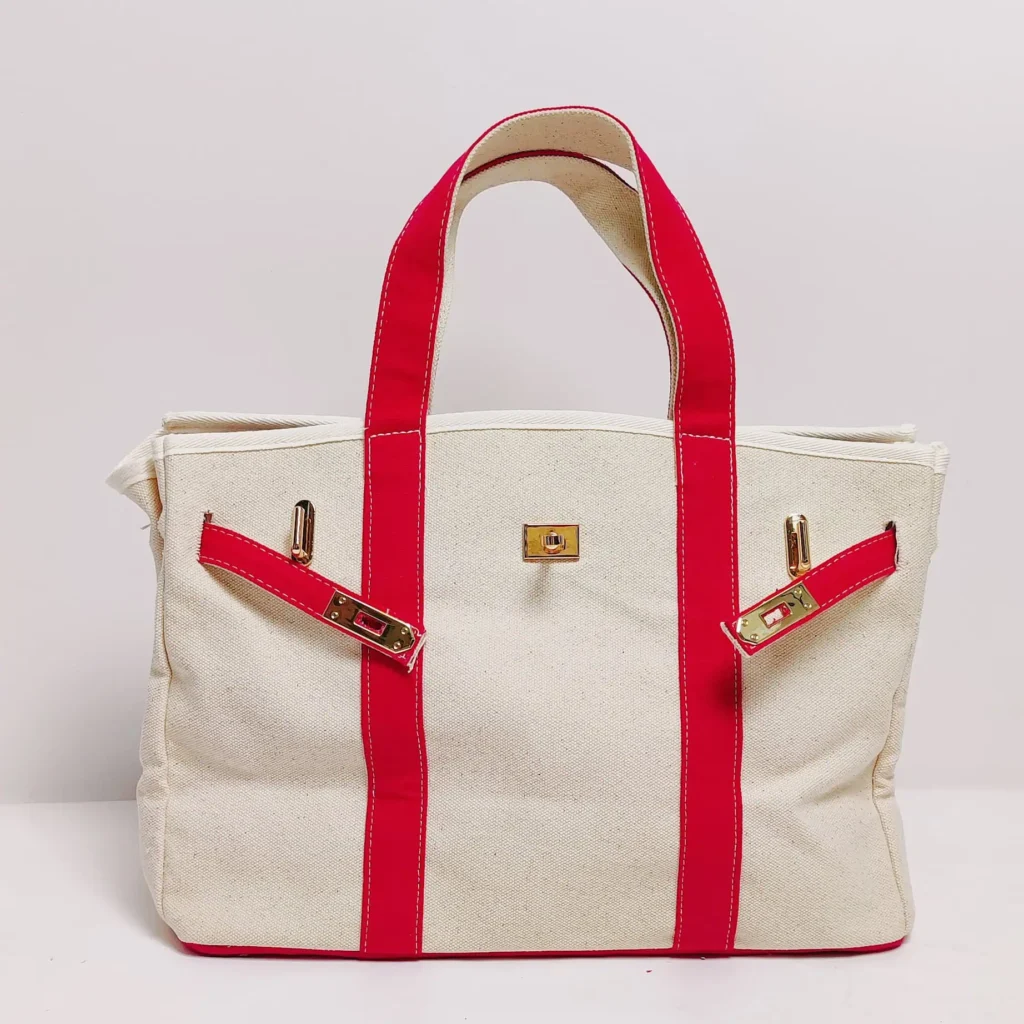
Several brands moved quickly to offer Boatkin-adjacent products:
- Sweevly launched a canvas structured tote at \$69.99 — and accumulated over 4,500 reviews before selling out
- Coral Strands offers a Boatkin-branded version at \$125, selling from Key West in 10 colorways, with a wholesale program for shop owners
- Etsy and Poshmark sellers continue to resell original Boatkins at significant premiums
The market has validated demand. Sweevly’s 4,521 reviews on a single product at \$69.99 represents over \$315,000 in revenue from one SKU, and it’s sold out.
The Silhouette That Drives the Demand
Here’s the key insight for brand builders: the Boatkin’s success isn’t really about the Birkin reference or the L.L. Bean canvas. Those are cultural hooks that drove initial viral attention.
What created sustained commercial demand is the underlying silhouette:
A structured, open-top or light-closure canvas tote with contrast handles, a flat rigid base, and a slightly tapered trapezoid body.
This is a bag shape that:
- Works for daily carry (office, errands, travel, beach)
- Photographs extremely well (structured = great product images)
- Appeals to a wide age range (20s through 50s)
- Has genuine cross-occasion versatility
- Is easy to produce at scale with consistent quality
The Boatkin gave this silhouette a cultural moment. That moment is already embedded in consumer memory, which means search intent, social sharing, and purchase motivation will continue to flow to products that match this design language.
What a Successful Boatkin-Style Tote Looks Like in 2026
Based on the market data from Coral Strands, Sweevly, and the original Hathaway Hutton design, here’s what the winning product configuration looks like:
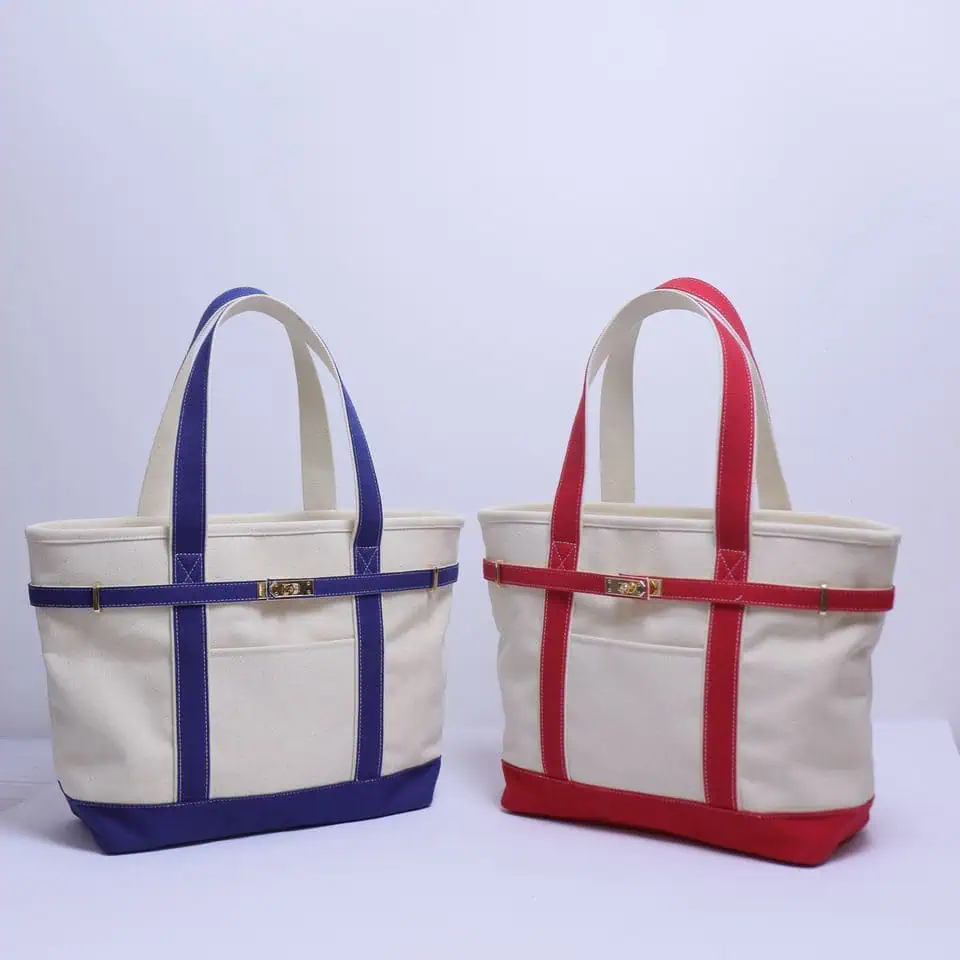
Structure
- Trapezoidal body — slightly wider at base than top
- Flat, reinforced base — rigid enough to stand upright when filled
- Height: 35–42cm | Width: 30–38cm | Depth: 12–18cm
- Semi-structured sides — holds shape but has slight flexibility
Material
- Exterior: Heavy canvas (12–16oz cotton or cotton-blend). This is non-negotiable for the Boatkin aesthetic — leather or PU does not produce the same cultural resonance.
- Interior: Cotton canvas lining or bare canvas interior (utilitarian aesthetic)
- Base reinforcement: Internal board or thick interfacing — the flat base is a key quality signal
- Handles: Contrast color canvas webbing or leather — the contrast handle is the design’s most recognizable element
Hardware
- Gold-tone hardware — D-rings for handle attachment, clasp or turn-lock at top (optional)
- Heavy-gauge zipper (if closure) or magnetic snap (for lighter closure)
- The hardware is the single element that elevates this from a utility tote to a fashion tote
Colorways
Coral Strands’ 10-colorway lineup provides a good market map:
- Navy + contrast canvas handles — the closest to L.L. Bean DNA; broadest appeal
- Green (forest/emerald) — strong performer; outdoorsy and fashion-forward simultaneously
- Red — bold, gift-friendly, high visual impact
- Pink — drives social sharing; younger demographic
- Camo — niche but passionate customer base
- Black — baseline for any tote collection
- Natural/cream — minimalist, quiet luxury positioning
Piping detail (as offered by Coral Strands’ “Exclusive Design” line) adds perceived value at modest production cost and creates an easy SKU differentiation between entry-level and premium versions.
Positioning Your Brand in the Boatkin Market
The Boatkin demonstrated that this silhouette can be sold at multiple price tiers. Here’s how to think about positioning:
| Tier | Price Point | Differentiator | Target Customer |
|---|---|---|---|
| Entry | \$55–\$80 | Value, colorway range | Price-sensitive first-time buyers |
| Mid | \$85–\$130 | Gift buyers, quiet luxury customers | Quality-conscious daily carry shopper |
| Premium | \$140–\$200 | Heavy canvas, leather handles, full lining | Gift buyers, quiet luxury customer |
Which tier to enter: The \$85–\$130 mid tier is currently underserved. Sweevly’s \$69.99 version sold out and is no longer available. Coral Strands’ \$125 version has limited inventory and a slow replenishment cycle. The gap is in a product that’s better than entry-level but more accessible than Coral Strands.
Positioning angle for brand founders:
The Boatkin’s story gives you a ready-made narrative: “The bag that went viral — now available again, built to last.” You don’t need to explain the product category from scratch. The cultural context already exists.
Production Cost and Margin Analysis
| Configuration | Factory Price (FOB China) | Suggested Retail | Gross Margin |
|---|---|---|---|
| Canvas, basic, no closure, contrast handles, MOQ 100 | \$9–14 | \$64.99–\$79.99 | 78–86% |
| Canvas, piping detail, interior pocket, snap closure | \$13–19 | \$89.99–\$109.99 | 78–83% |
| Heavy canvas, leather handles, full lining, turn-lock | \$18–28 | \$119.99–\$159.99 | 77–82% |
| Premium canvas, leather handles, piping + pocket, MOQ 200 | \$22–32 | \$149.99–\$199.99 | 79–85% |
Canvas construction is among the most cost-efficient in handbag manufacturing. The margin profile is strong across all tiers.
Why Canvas Tote Manufacturing Requires Specific Expertise
Not all bag factories handle heavy canvas well. The Boatkin-style tote has specific production requirements that differentiate good and poor execution:
1. Canvas weight and weave consistency
The 12–16oz canvas required for the structured tote silhouette is heavier than standard bag canvas. Factory experience with this weight is important — lighter canvas will produce a bag that doesn’t hold its shape.
2. Baseboard attachment
The flat, rigid base requires an internal stiffening board (typically PP board or fiberboard) attached to the base interior. Poor attachment leads to the most common quality complaint on canvas totes: the base warping or shifting after use.
3. Handle stitching strength
Contrast canvas webbing handles need reinforced bar-tack stitching at attachment points. This is the highest-stress area on any tote bag. Verify the factory uses bar-tack reinforcement, not single-line stitching.
4. Piping execution
Piping (the cord-filled trim that defines edges) requires a separate piping foot on the sewing machine and specific operator skill. Factories without piping experience will produce uneven, unprofessional-looking trim.
5. Color matching across batches
If you’re producing multiple colorways, color consistency across production runs is critical — especially for canvas, which dyes differently than leather. Ask for a color-matched sample from each colorway before approving bulk.
What to Ask Before Placing a Canvas Tote Order
- Do you have existing structured canvas tote samples? Request a sample of a tote with a rigid base, contrast handles, and piping before committing.
- What canvas weights do you work with? You want 12oz minimum; 14–16oz for premium positioning.
- How do you attach the base reinforcement? Ask for photos of the internal construction.
- What stitching reinforcement do you use at handle attachment points? Answer should reference bar-tack or box-x stitch.
- Can you produce contrast handle color matching to a Pantone swatch? Critical for colorway consistency.
- What’s your colorway MOQ? Typically, 100 units per color; understand the minimum before planning your SKU lineup.
Timeline for Getting to Market
| Phase | Timeline |
|---|---|
| Sample request with specs | Week 1 |
| Sample development | Week 2–3 |
| Sample review + revision | Week 3–4 |
| Bulk production (100–300 units) | Week 5–8 |
| Shipping (sea freight to USA) | Week 9–11 |
| Product available for sale | Week 12–13 |
Total time from first contact to sales-ready inventory: approximately 10–13 weeks.
The Boatkin is a year-round silhouette — unlike raffia or straw bags, it has no seasonal cliff. You can launch any month and expect consistent demand.
Manufacture Your Canvas Structured Tote with Largeng Bags
At Largeng Bags, we manufacture canvas and leather tote bags from our factory in Quanzhou, China. We have direct experience producing structured canvas totes with:
- Heavy canvas (12–16oz) in stock, multiple colors
- Rigid base board internal construction — standard on our structured totes
- Bar-tack reinforced handle attachment — factory standard
- Piping detail capability — in-house, not outsourced
- Contrast handle color matching to the Pantone specification
- Interior pocket and lining options
- Low MOQ from 100 pieces per colorway
- Sample turnaround in 7–15 days
- OEM & ODM — bring your own design or adapt from our existing styles
Whether you’re launching a direct response to the Boatkin demand, building a tote collection around this silhouette, or adding a structured canvas tote to an existing line, we can build it.
Request a Free Quote for Canvas Structured Tote Manufacturing →
Include your target size, colorway preferences, and retail price point. We’ll respond with a detailed quote within 12 hours.
The Bigger Picture: What the Boatkin Taught the Market
The Boatkin’s rise and fall is a case study in how viral fashion moments create lasting commercial demand.
Hathaway Hutton couldn’t scale to meet the demand — she was making each bag by hand, 10 hours per unit, at a \$1,200 minimum price. The viral moment created far more demand than the supply model could support.
Sweevly moved fast with a \$69.99 mass-market version and accumulated 4,500+ reviews. But they’re sold out. Coral Strands sells a more premium \$125 version, but inventory is limited, and the colorway expansion is slow.
The market is telling you something: there is consistent, proven demand for a structured canvas tote in the Boatkin silhouette, at the \$85–\$150 retail price tier, and no brand currently owns the category.
The brand that manufactures this product at the right quality, launches with the right positioning, and builds the inventory to meet demand is the brand that captures what the Boatkin’s creator couldn’t.
Frequently Asked Questions
Q: Is it legal to manufacture a bag inspired by the Boatkin silhouette?
The Boatkin’s legal issue stems from its close visual reference to the Hermès Birkin’s specific trade dress — not the canvas tote silhouette itself. A structured canvas tote with contrast handles is a generic design category that existed long before the Boatkin. Countless brands, including L.L. Bean, produce variations of this silhouette without IP issues. The key is not to directly copy protected design elements (specific hardware configurations, color combinations, or branding that reference Hermès).
Q: How many colorways should I launch with?
Start with 3: Navy (broadest appeal), Black (baseline necessity), and one statement color (Red, Green, or Pink, depending on your brand aesthetic). Add colorways in batches of 2–3 based on sell-through data.
Q: Can I add custom branding to the canvas?
Yes — we offer embossed leather patches, woven labels, screen-printed branding on the canvas body, and embroidered logos. All are available at low MOQ with a one-time setup cost.
Q: What’s the best closure type for this silhouette?
Magnetic snap closure is the most popular for the open/relaxed tote feel. If you’re targeting a more premium buyer, a turn-lock clasp adds a luxury signal. Zipper closures are more functional but change the visual silhouette of the bag.
Q: How do I prevent the base from sagging in production?
This is controlled at the factory level through proper baseboard selection and attachment method. Our standard structured totes use a PP board base with perimeter stitching — this prevents sagging and maintains the flat base profile over time.
Largeng Bags is a professional OEM & ODM handbag and tote bag manufacturer based in Quanzhou, China, with 15+ years of experience producing for global brands. We manufacture leather bags, canvas totes, backpacks, and accessories. Learn more about our factory →