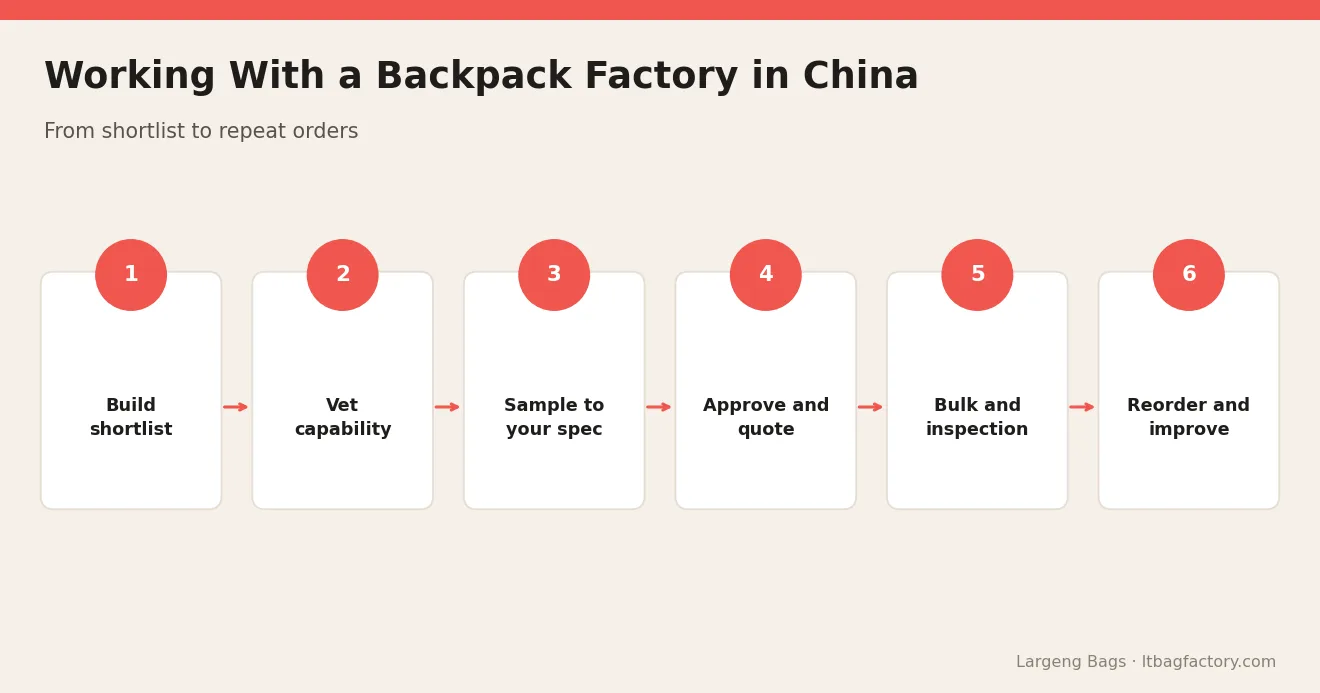
Finding the right backpack factory in China comes down to three steps: build a shortlist from reliable channels, vet each supplier on real capability rather than photos, and test the relationship with a sample before bulk. China has many backpack manufacturers, from small workshops to large plants, so the right fit depends on your product, volume and support needs. This guide explains each step from the view of a backpack manufacturer in Quanzhou, Fujian.
Why Buyers Look for a Backpack Factory in China
China remains a major source of backpacks because of its dense supply chain. Fabrics, webbing, zippers, buckles, foam and packaging are often available close to the factory, which makes sampling and material changes faster.
Fujian, including Quanzhou, is one of the regions known for bags, sportswear and outdoor products. Many factories there produce school, sports, travel and laptop backpacks for OEM and ODM clients.
- Wide material and hardware choice near production
- Experience with export packing and documentation
- Range of factory sizes for different order volumes
- Ability to develop both simple and technical designs
Cost is only part of the picture. Buyers also value the ability to combine product development, sampling and bulk production with one partner, and to scale from a first order to repeat programs without changing suppliers.
Where to Find China Backpack Suppliers
Each channel has strengths and gaps. Using two or three together gives a more balanced shortlist.
| Channel | Strength | Watch out for |
|---|---|---|
| B2B marketplaces | Large choice, quick contact | Traders listed as factories |
| Trade fairs | See samples and meet teams | Timing and travel cost |
| Factory websites and search | Direct contact, clear focus | Check claims with documents |
| Referrals from other brands | Proven track record | Capacity may be limited |
| Sourcing agents | Local support | Added cost, less direct contact |
Whichever channel you use, ask early whether you are talking to the production factory or a trading company. Both can work, but you should know which one you are dealing with.
How to Vet China Backpack Manufacturers
Photos and catalogs show what a supplier can sell, not always what it can make. Focus your questions on production reality.
- Ask what backpack types they make most often and for which markets
- Request photos or video of cutting, sewing and inspection areas
- Ask who develops patterns and samples, and how long sampling takes
- Check how they source and test fabrics, zippers and buckles
- Ask for a sample made to your specification, not a stock item
- Confirm who handles packing, labeling and export documents
For a fuller list of checks, see our China bag manufacturer buyer checklist. If certifications or audits matter for your market, ask each supplier for current documents and verify them directly.
Also watch how quickly and specifically a supplier answers. Vague replies to technical questions before an order often signal vague answers later, when problems are harder to fix.
Factory Types and Which Fits Your Order
| Supplier type | Typical fit | Consideration |
|---|---|---|
| Small workshop | Very small or simple runs | Limited development and QC depth |
| Mid-size OEM/ODM factory | Brands, wholesalers, startups growing | Balance of flexibility and capacity |
| Large plant | Very high, repeat volumes | Higher minimums, less flexibility |
| Trading company | Mixed product sourcing | Less control over production |
For most growing brands, a mid-size OEM and ODM factory offers a good balance. As a reference point, our Quanzhou facility covers 5,000 m² with 200+ skilled workers and production staff, serving buyers in 30+ countries. More about our background is on our about us page.
Size alone does not decide quality. A smaller factory with a stable team and clear processes may serve a growing brand better than a very large plant where smaller orders get less attention. Ask how your order will be scheduled and who will manage it day to day.
Sampling: The Real Test of a Backpack Factory
A sample shows how a factory reads your specification, handles detail and communicates. We make samples within 7–15 days depending on design complexity and material sourcing.
- Check dimensions and compartment layout against the brief
- Look at stitching density, bartacks and edge binding
- Test zippers, buckles and strap adjusters
- Review logo position, color and finish
- Note how clearly the factory explains any changes
Our custom bag sampling process page walks through each stage and what to approve.
MOQ, Lead Time and Terms
Minimum order quantities for backpacks depend on style, material and logo method, and are confirmed on the quotation. Custom fabrics, dyed webbing or molded parts usually raise the minimum compared with stock materials.
Bulk lead time, shipping terms and payment terms are also confirmed on the quotation. For a closer look at how these are set for backpacks, see our guide to OEM backpack MOQ and lead time.
Working With a Backpack Factory Over Time
The first order is where trust is built. Clear, consistent communication matters more than speed of reply. Agree on one specification document, update it after every change and keep the approved sample as the reference.
- Share forecasts early so materials can be planned
- Confirm any change in writing before it reaches production
- Agree on inspection points and tolerances
- Review each shipment and feed issues back quickly
Our backpack manufacturer page shows the backpack types we make for OEM and ODM clients.
Long-term relationships also make improvement easier. With each reorder, the factory learns your standards, and small refinements such as a better puller or stronger bartack can be added without starting a new development project.
Communication and Specification Control
Many problems with China backpack manufacturers are not about skill but about information. A detail that seems obvious to the buyer, such as the direction of a zipper pull or the exact shade of webbing, may be interpreted differently at the factory if it is not written down.
- Use one master specification with a version number and date
- Mark every change clearly, with a photo or sketch
- Confirm colors with physical swatches or Pantone references
- Name one contact person on each side for approvals
- Keep all approvals in writing, even after a call
Time zones can also slow approvals. Grouping questions and answering them in one message usually moves a project forward faster than many short replies. A short weekly update during bulk production keeps both sides aligned.
| Stage | What to confirm | Reference |
|---|---|---|
| Before sampling | Specification and materials | Tech pack or brief |
| After sample | Changes and approval | Approved sample |
| Before bulk | Bulk materials match | Material swatches |
| Before shipment | Inspection result | Inspection report |
What to Send for a Quote
To get a useful quote from a backpack factory in China, send your request with these details.
- Backpack type, size and capacity, with reference images or a tech pack
- Main fabric, lining and padding
- Hardware: zippers, buckles, webbing
- Logo method and placement
- Quantity per color and your target market
- Packing and labeling requirements
If your design is still early, send a sketch and your use case. We can suggest construction and materials.
Frequently Asked Questions
How can I tell if a supplier is a real backpack factory?
Ask for recent video of the cutting and sewing floor, the factory address and business documents, and a sample made to your specification. A factory can usually explain its production steps in detail. A trading company may be open about sourcing from partners, which is fine as long as you know.
Do I need a tech pack before contacting backpack manufacturers?
A tech pack helps, but it is not always required. Many buyers start with reference photos, a sketch and a list of features. The factory then builds a specification and a sample. The clearer the starting brief, the fewer sample rounds you will usually need.
Can a backpack factory in China help with design?
Many can. ODM factories offer existing designs that you can adapt with your materials, colors and logo. Some also offer pattern development from your sketch. Ask which parts of design the factory handles and which you need to provide, so responsibilities are clear before sampling starts.
Should I visit the factory before ordering?
A visit is useful for larger or long-term programs, but not always necessary for a first order. Video calls, a sample made to your specification and a third-party inspection before shipment can give good confidence. Many buyers visit once the relationship is established and volumes grow.
What happens if bulk production does not match the sample?
Agree on quality standards, tolerances and inspection points before production. Inspections during and after production help catch issues early, while they can still be fixed. Keep the approved sample as the reference, and document any differences with photos so they can be discussed and resolved clearly.