A good lawn bowls trolley bag rolls smoothly on paths and grass, carries four bowls plus shoes and clothing, and stays stable when parked beside the green. The choices that matter most are the wheels, the handle, the compartment layout and the base. This guide breaks down trolley bag anatomy, looks at example models from well-known bowls brands, and gives clubs, retailers and distributors a spec checklist for developing their own trolley bags with a factory.
Lawn Bowls Trolley Bag Anatomy
Most trolley bags share the same basic structure. Understanding each part makes it easier to compare samples and write a clear specification.
| Component | What it does | What to check |
|---|---|---|
| Wheels and axle | Carry the load over paths and grass | Wheel diameter, tread, axle fixing |
| Telescopic or fixed handle | Lets the bowler pull the bag | Height settings, grip, locking |
| Bowl compartment | Holds a set of four bowls | Padding, divider, access opening |
| Shoe and clothing areas | Separates footwear and wet gear | Ventilation, lining, size |
| Base and feet | Protects the bag when parked | Waterproof material, stability |
| Accessory pockets | Store measure, jack, cloths, valuables | Zips, lining, placement |
Trolley bags are heavier than carry bags, so frame, wheel and handle quality decide how the bag performs after a season of use.
Choosing Wheels for Grass and Paths
Wheels are the first thing bowlers notice. Larger wheels typically roll more easily over grass, kerbs and gravel paths, while smaller wheels keep the bag compact for car boots and lockers.
Wheel material matters as much as size. Hard plastic wheels are light and low-cost, while rubber or rubber-tread wheels are often quieter and grip better on wet surfaces. Recessed wheels reduce the chance of catching on door frames.
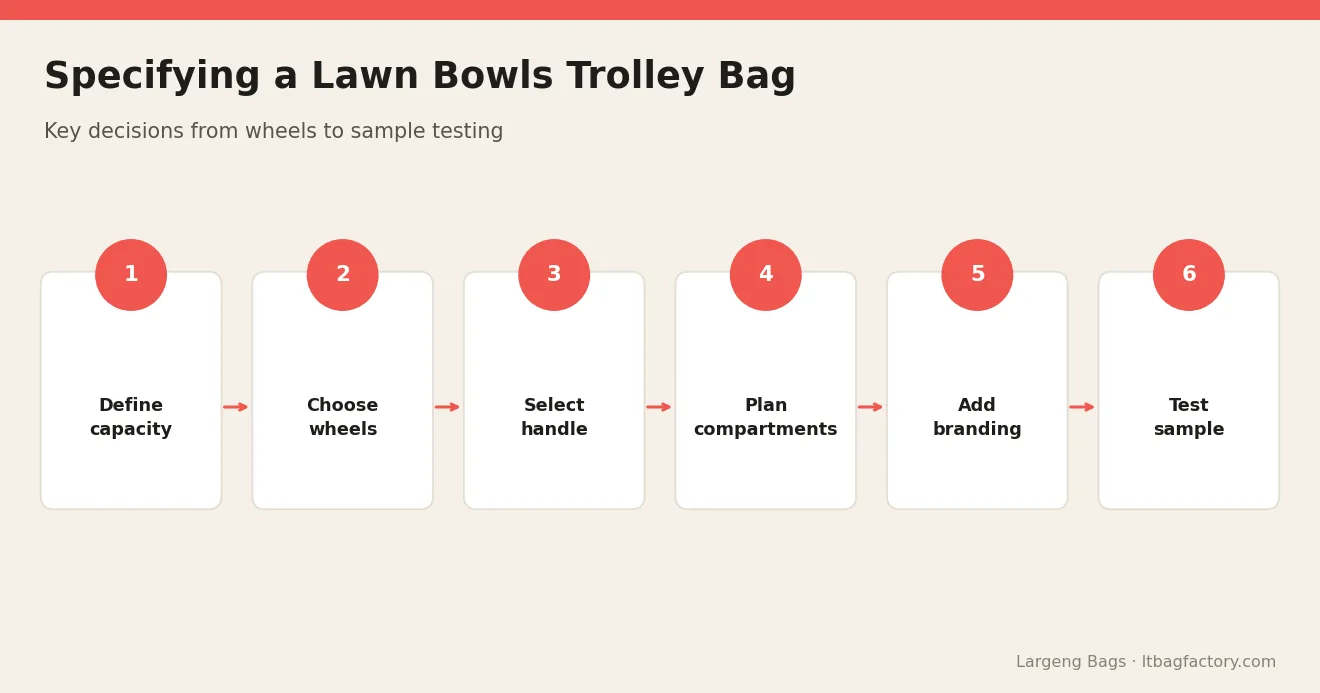
Ask how the axle is fixed to the frame. A metal axle running through a reinforced base tends to resist bending under the weight of four bowls. During sampling, load the bag fully and pull it over an uneven surface rather than only testing it empty on a smooth floor.
Handles: Telescopic, Fixed and Carry Options
A telescopic handle is the most common choice on modern trolley bags. It extends for pulling and retracts so the bag fits in a car or locker. Look for a firm lock at each height and a grip that is comfortable in cold or wet weather.
Fixed handles are simpler and have fewer moving parts, which some buyers prefer for club bags that will be used by many members. Either way, most trolley bags also need carry handles on the top or side, because bowlers still lift them into cars and up steps.
- Check the number of height positions on telescopic handles.
- Ask whether the handle tube is aluminium or another metal.
- Confirm the handle retracts fully without blocking the main zip.
- Test grab handles with a fully loaded bag.
Compartments: Bowls, Shoes, Clothing and Valuables
The compartment layout is where trolley bags differ most. A typical layout puts the bowls low in the bag for stability, with shoes in a separate pocket and clothing or wet-weather gear above.
Bowl compartments are usually padded and sometimes divided, so bowls do not knock together. Some designs use separate bowl pockets that open from the side; others use a single padded section with a top opening.
A ventilated shoe compartment keeps damp footwear away from clothes. A small zipped valuables pocket, often lined, is useful for keys, phones and wallets. Many bowlers also expect dedicated spots for a measure, jack and cloths, plus a scorecard or pencil holder. Agree each of these on the sketch before sampling so nothing is missed.
The base deserves equal attention. Because a trolley bag is parked on damp grass and pulled over wet paths, a waterproof or coated base is strongly recommended. Small protective feet keep the fabric off the ground, and a rigid base panel helps the bag stand upright when it is parked. Ask the factory how the base joins the wheel housing, because that seam carries much of the load.
Example Trolley Bag Models from Leading Brands
Several established bowls brands offer trolley bags, and their model names are often used as reference points when bowlers describe what they want. The examples below are drawn from publicly listed ranges.
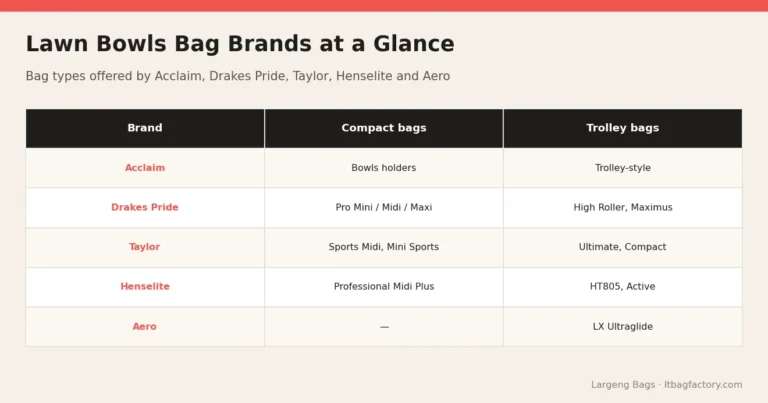
| Brand | Trolley bag examples | Background |
|---|---|---|
| Drakes Pride | High Roller, Low Roller, Horizon Locker, Maximus | UK bowls brand established in the early 1980s |
| Taylor | Ultimate, Sports Tourer, Compact | Family-run Scottish bowls business |
| Henselite | HT805 trolley bag, Active trolley bag | Founded in Australia in 1930 by the Hensell family |
| Aero | LX Ultraglide trolley bag | Australian maker known for bowls and grips |
| Acclaim | Trolley-style bags at the top of its range | Bowls brand specialising in bags |
These models show how much variety exists within one category, from compact trolleys to larger locker-style bags. A private-label trolley bag should be developed to your own design and positioning rather than modelled on any one of them.
Lawn Bowls Trolley Bag Spec Checklist for Buyers
Use this checklist when you brief a factory. It helps the supplier quote accurately and reduces the number of sample rounds.
- Capacity: four bowls plus shoes, clothing and accessories, or a smaller compact trolley.
- Wheels: size, material and whether they are recessed.
- Handle: telescopic or fixed, number of positions, grip material.
- Outer fabric: polyester, nylon or a mix, with colour references.
- Base: waterproof material and protective feet.
- Pockets: valuables, measure, jack, cloths and scorecard.
- Branding: logo position, method and size.
- Packaging: polybag, carton and any retail hang tag.
For zips, buckles and other trims, our bag hardware guide explains what to specify.
Sampling and Testing a Trolley Bag
Trolley bags combine fabric, padding, plastic and metal parts, so a sample is the only reliable way to check fit and function. A pre-production sample confirms that the approved materials and construction carry through into bulk.
When you test, load the bag with a real set of bowls, shoes and a jacket. Pull it over grass, gravel and steps. Check that the bag stands upright when parked, that the handle locks firmly and that zips open smoothly when the bag is full.
Retailers planning a mixed range can also read our lawn bowls bag buying guide for retailers for advice on balancing trolley and carry styles.
What to Send for a Quote
The faster we understand your project, the faster you receive an accurate quotation. Please include as much of the following as you can:
- Sketch or reference photos of your own trolley bag design
- Wheel, handle and compartment requirements from the checklist above
- Fabric, colour and logo details
- Estimated quantity per colour and target market
Our custom lawn bowls bag manufacturing team will review your brief and suggest construction options. Samples are typically ready in 7–15 days; MOQ and bulk lead time are confirmed on the quotation. Send your enquiry to get started.
Brand names mentioned are trademarks of their respective owners; Largeng Bags is an independent OEM manufacturer and is not affiliated with them.
Frequently Asked Questions
Are trolley bags better than carry bags for lawn bowls?
It depends on the bowler. Trolley bags suit players who walk some distance from the car park or carry a full kit with shoes and wet-weather gear. Carry bags are lighter and simpler to store. Many clubs and retailers offer both so members can choose based on their routine and preferences.
What wheel size suits a lawn bowls trolley bag?
There is no single correct size. Larger wheels typically roll more easily over grass and uneven paths, while smaller wheels keep the bag compact. The best approach is to sample the bag fully loaded and test it on the surfaces your customers actually use, such as gravel paths and clubhouse steps.
Can a trolley bag be produced in club colours?
Yes. Outer panels, trims, zip tapes and webbing can usually be matched to club colours, and logos can be embroidered, printed or applied as patches. Share Pantone references or physical swatches so the factory can propose suitable fabrics and confirm colour accuracy during sampling.
How do I compare trolley bag samples from different suppliers?
Load each sample with the same set of bowls, shoes and clothing, then compare how they roll, park and open. Check handle locking, wheel fixing, base stitching and zip quality. Also compare how well each supplier followed your specification, because that indicates how carefully bulk orders will be managed.
Does a trolley bag need a waterproof base?
A waterproof or water-resistant base is strongly recommended, because trolley bags are often parked on damp grass or wet paths. A coated or moulded base with small protective feet helps keep the contents dry and reduces wear on the fabric where the bag touches the ground most often.